Winter running gear: layering system that works
Five minutes into a January run, the runner who dressed for the thermometer is sweating. Fifteen minutes in, the sweat has soaked through the jacket. Twenty-five minutes in, the wind hits the wet fabric and the runner is freezing — not from the cold outside, but from the cold they generated themselves. This is the central paradox of winter running, and it catches nearly everyone the first time the temperature drops below freezing: you do not dress for the temperature, you dress for the heat your body produces while running. A runner generating 700 to 1,000 watts of thermal output at an easy pace is a furnace, and the clothing system must manage that heat — trapping enough to keep muscles warm and skin protected, while releasing enough to prevent the sweat that becomes the real enemy. The layering system is the solution, and it is not a fashion concept or a marketing framework — it is a thermal engineering principle applied to the body, where each layer has a specific job and the interaction between layers determines whether you finish warm and dry or cold and soaked.
The physics of running in cold weather
Understanding why layering works requires understanding what happens to the body during cold-weather running. The working muscle produces heat as a byproduct of energy conversion — only about 20 percent of the energy from food becomes mechanical work, and the remaining 80 percent becomes heat. In summer, the body dissipates this heat primarily through sweating and evaporation. In winter, the body still produces the same heat but the environmental gradient — the difference between skin temperature and air temperature — is much steeper, which means heat is lost faster to the environment.
The runner's challenge is balancing two competing demands. The first is insulation: the body must retain enough heat to keep the working muscles at optimal temperature (around 37°C core, with muscle temperature slightly higher) and to protect exposed skin from wind chill and frostbite. The second is ventilation: the body must release enough heat to prevent core temperature from rising too high, because overheating in cold weather is not just uncomfortable — it is dangerous. Sweat that soaks the clothing system loses its insulating properties, and when the runner stops or slows down, the wet fabric conducts heat away from the body at a rate that can cause hypothermia even at temperatures above freezing.
The layering system addresses this paradox by separating the functions of insulation and ventilation into distinct layers, each of which can be adjusted independently. The base layer manages moisture. The mid-layer traps heat. The shell blocks wind and water. When the runner heats up, the shell can be opened or removed to release heat. When the runner cools down — on a downhill, at a traffic light, or when the wind changes — the shell can be closed to trap heat. The system is dynamic because running is dynamic, and the ability to adjust on the move is what makes layering superior to any single garment, no matter how technologically advanced.
The base layer: moisture management starts here
The base layer is the fabric that sits directly against the skin, and its job is singular: move moisture away from the skin as quickly as possible. The base layer is not for warmth — it is for dryness. A base layer that keeps the skin dry allows the rest of the system to function, because every subsequent layer depends on the base layer having moved the moisture out. If the base layer traps sweat, the mid-layer gets wet, the shell gets wet, and the entire system fails.
Material choices for the base layer
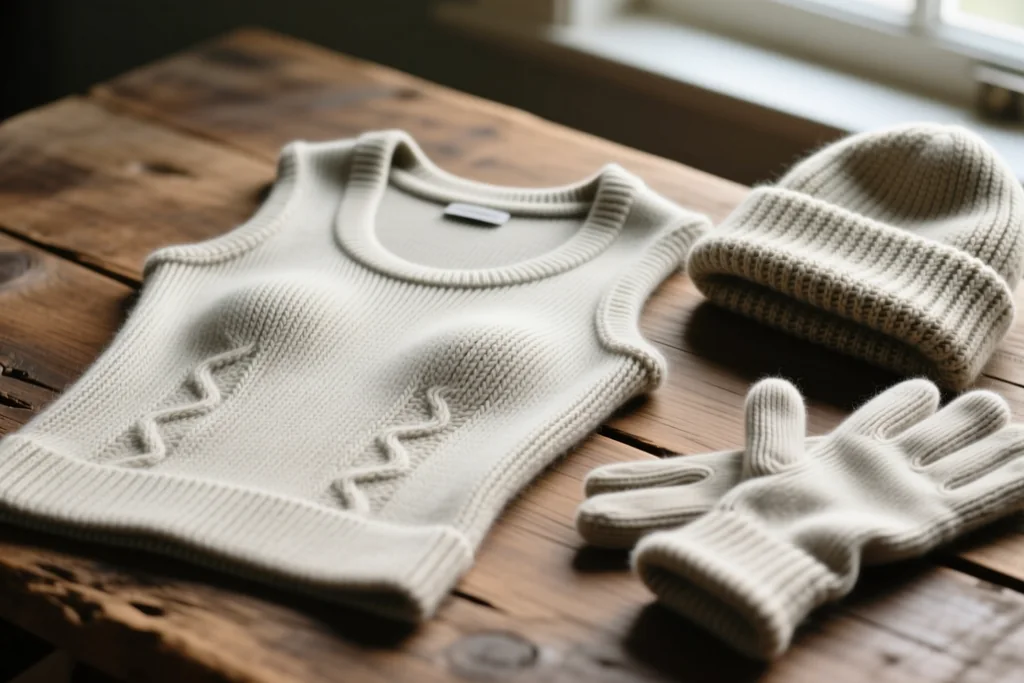
Merino wool is the gold standard for winter running base layers, and for good reason. As discussed in detail in the context of running socks, merino absorbs up to 35 percent of its weight in moisture without feeling wet, regulates temperature in both directions, and resists odor naturally. For winter running, the temperature regulation is the critical property: merino traps a layer of warm air against the skin while the moisture is absorbed into the fiber, keeping the skin warm even as it manages sweat. A merino base layer with a weight of 150 to 200 grams per square meter is ideal for most winter running conditions — light enough to avoid overheating, dense enough to provide meaningful insulation.

Synthetic base layers — polyester and polyester-elastane blends — are the alternative. They wick moisture faster than merino, dry faster, and are less expensive. For runners who sweat heavily or who run in conditions where the base layer will be soaked (heavy rain, deep snow), the faster wicking of synthetics may outweigh merino's temperature regulation advantage. The trade-off is odor: a synthetic base layer will smell after one run, while merino can be worn for multiple sessions.
Cotton has no place in a winter running base layer. Cotton absorbs moisture and holds it against the skin, creating a wet layer that conducts heat away from the body at approximately 25 times the rate of dry fabric. A cotton t-shirt under a winter running jacket is not just ineffective — it is a hypothermia risk. The runner who wears cotton in winter is carrying a wet towel against their skin that will freeze if they stop moving.
Fit: tight but not restrictive
The base layer must fit close to the skin to function. A loose base layer creates air gaps between the fabric and the skin, and those air gaps fill with sweat that cannot be wicked away — because the fabric is not in contact with the skin to pull the moisture. The fit should be compressive enough that the fabric is in full contact with the skin across the entire torso and arms, but not so tight that it restricts breathing or arm movement. The base layer should feel like a second skin — present but not felt.
The mid-layer: the insulation engine
The mid-layer is where the warmth lives. Its job is to trap the body heat that the base layer has allowed to escape from the skin, creating a warm layer of air between the base layer and the shell. The mid-layer is the most variable component of the system, because the amount of insulation needed depends on the temperature, the wind, the intensity of the run, and the individual runner's metabolism.
Fleece: the running mid-layer standard
Polyester fleece is the dominant mid-layer material for winter running, and its popularity is justified by a combination of properties that no other material matches. Fleece is warm for its weight, because the brushed, napped surface creates thousands of tiny air pockets that trap heat. It is breathable — more breathable than any insulated jacket or windproof garment — which means that moisture vapor passing through the base layer can continue through the fleece and out of the system. It is lightweight and compressible, which means it can be carried in a pocket or waist belt if the runner needs to remove it mid-run. And it dries quickly, which means that even if it gets damp from sweat, it continues to provide insulation.
The weight of the fleece matters. A lightweight fleece (100-weight, approximately 200 grams per square meter) is sufficient for most winter running at temperatures from -5°C to 5°C, especially when paired with a windproof shell. A midweight fleece (200-weight, approximately 300 grams per square meter) extends the range down to -10°C or lower but may cause overheating during hard efforts. The runner who runs in temperatures below -10°C may need a heavyweight fleece or a combination of a lightweight fleece and an insulated vest — but at those temperatures, the risk of overheating is lower because the environmental gradient is steeper.
Insulated vests: the targeted warmth solution
An insulated vest — down or synthetic — is a specialized mid-layer that provides core warmth without arm insulation. The vest is valuable for runners whose arms generate enough heat during running that they do not need sleeve insulation, but whose core needs additional warmth. A vest over a base layer, under a shell, is a versatile combination that covers a wide temperature range — from 0°C down to -15°C depending on the runner and the wind conditions. The vest can also be worn over the shell as an emergency warmth layer if the runner slows down or stops.
Synthetic insulation is preferred over down for winter running. Down loses its insulating properties when wet — the feathers clump and the loft collapses — and a runner who sweats through the base layer into a down vest will find that the vest stops working. Synthetic insulation (Primaloft, Coreloft, and similar materials) retains 50 to 70 percent of its insulating value when wet, making it the safer choice for high-output activities like running.
The mistake of too much mid-layer
The most common mid-layer mistake is over-insulating. The runner who puts on a thick fleece because it is cold outside, then starts running and generates heat, finds that the mid-layer is trapping too much heat and the system is saturated with sweat. The solution is not to remove the mid-layer — it is to start with less. The runner should feel cold for the first five to ten minutes of a winter run — that cold is the body warming up to its operating temperature. The runner who is comfortable at the start of the run is overdressed and will be sweating within fifteen minutes. The rule of thumb is to dress for the temperature you will be at after ten minutes of running, not for the temperature at the front door.
The shell: wind and water protection
The shell is the outer layer, and its job is to protect the insulation layers from wind and precipitation while allowing moisture vapor to escape. The shell is the layer that makes or breaks the system, because it determines whether the heat the body produces stays in the system or is stripped away by the wind.
Wind shells vs. waterproof shells
For winter running, the choice between a wind shell and a waterproof shell is the most important gear decision, and the answer depends on the conditions the runner faces most frequently.
A wind shell is a thin, lightweight jacket that blocks wind but is not waterproof. It is typically made of a tightly woven nylon or polyester fabric with a durable water repellent (DWR) treatment that sheds light rain and snow. The key property of a wind shell is breathability — it allows moisture vapor to pass through while blocking the convective heat loss that wind causes. A wind shell is the right choice for dry, cold, windy conditions — which describe most winter running days in most climates.
A waterproof shell uses a membrane — Gore-Tex, eVent, or similar — that is both waterproof and breathable. The membrane has pores small enough to block liquid water but large enough to allow water vapor to pass through. In theory, this means the shell keeps rain out while letting sweat escape. In practice, the breathability of any waterproof membrane is significantly lower than that of a wind shell, because the membrane restricts vapor transfer. During high-output running, the body produces moisture vapor faster than the membrane can transfer it, and the result is moisture buildup inside the shell — the runner gets wet from their own sweat even though the rain is kept out.
For winter running, the wind shell is the better choice for most conditions. Wind chill is the primary cause of heat loss during running, and a wind shell eliminates convective heat loss at a fraction of the weight and with far better breathability than a waterproof shell. The waterproof shell is the right choice only when precipitation is heavy enough that a wind shell would soak through — which in winter usually means rain rather than snow, because snow slides off a DWR-treated wind shell.
The breathability trade-off
No shell is perfectly breathable. Even the most breathable wind shell restricts some vapor transfer, and the waterproof shell restricts significantly more. The runner who understands this manages the shell as a dynamic component — opening the front zipper or underarm vents during hard efforts to release heat and moisture, closing them during easy efforts or downhill sections to trap heat.
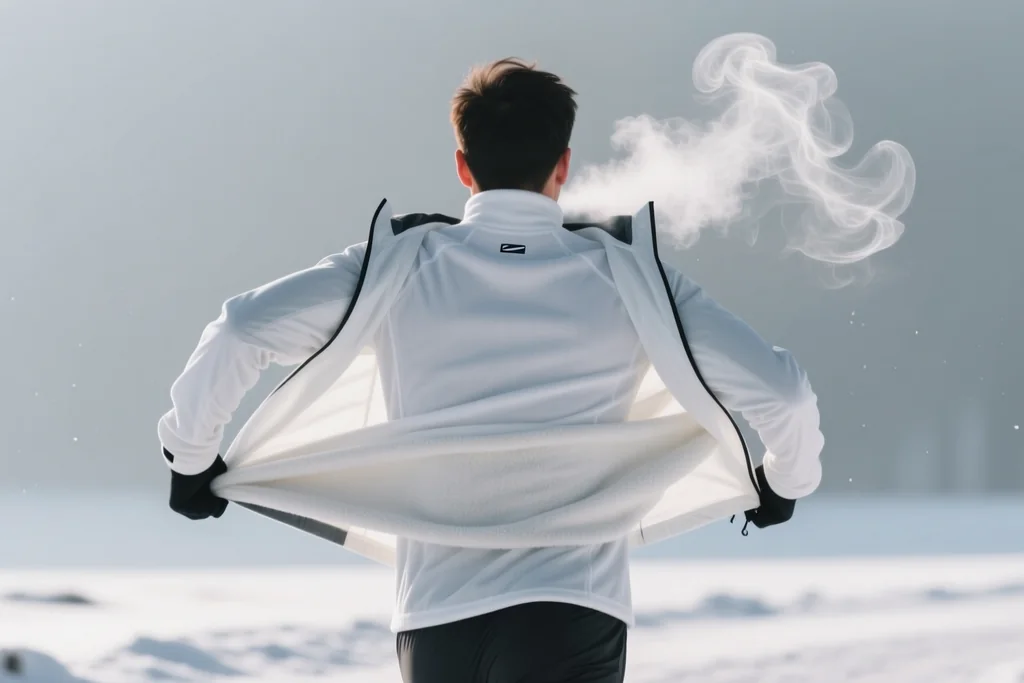
The key to managing shell breathability is to treat the shell as a valve, not a wall. The fully zipped shell traps everything — heat, moisture, and wind. The half-zipped shell releases heat and moisture from the chest area while still protecting the torso. The unzipped shell with the front open turns the jacket into a wind blocker that allows maximum ventilation through the front opening. The runner who adjusts the zipper based on effort and wind direction maintains thermal balance without adding or removing layers.
Bottom half: tights and pants
The lower body receives less attention than the upper body in winter running discussions, but the legs are subject to the same thermal challenges — and the solutions are different because the legs are the primary heat-generating muscles during running. The quadriceps, hamstrings, and glutes produce the majority of the body's running heat, which means the legs need less insulation than the torso and are more prone to overheating.
Tights: the winter running standard
Running tights are the standard lower-body garment for winter running at temperatures from approximately 5°C down to -10°C. Tights provide a compressive fit that moves with the body, they trap a thin layer of warm air against the skin, and they wick moisture the same way a base layer does — through synthetic or merino fibers in close contact with the skin.
The thickness of the tights determines their temperature range. Lightweight tights (sometimes called "running pants" or "trainer tights") are suitable for 5°C to -2°C. Midweight tights extend the range to -8°C. Heavyweight tights, sometimes with a brushed fleece interior, extend the range to -15°C. Below -15°C, most runners add a windproof layer over the tights — either wind briefs for the groin or a windproof panel on the front of the tights.
Windproof panels and the front-to-back asymmetry
The body does not need the same insulation on all sides. The front of the legs — the quadriceps and shins — faces the wind and needs protection from convective heat loss. The back of the legs — the hamstrings and calves — is sheltered from the wind and needs more ventilation to release the heat the muscles produce. Many winter running tights address this asymmetry with windproof panels on the front and breathable panels on the back. This design is more effective than uniform tights because it protects the wind-exposed surfaces while allowing heat to escape from the wind-sheltered surfaces.
The shorts-over-tights debate
The aesthetic question of whether to wear shorts over tights is a personal preference that has no effect on performance. Some runners prefer the look of shorts over tights; others find the extra layer unnecessary and prefer the streamlined appearance of tights alone. Neither choice affects warmth, breathability, or function. The only practical consideration is that shorts over tights provide a pocket for a phone or key, which some tights do not have.
Extremities: where the cold hits first
The hands, feet, and head are the extremities that lose heat fastest in cold weather, and they are the areas where most winter runners fail to prepare adequately. The body prioritizes core temperature over extremity temperature — when the core starts to cool, the body constricts blood flow to the hands and feet to preserve heat for the organs. This means that cold hands and feet are not just uncomfortable — they are a warning that the core is losing heat and the body is sacrificing the extremities to protect the organs.
Gloves: the layering principle applies to hands too
The hands benefit from the same layering principle as the torso. A thin liner glove — typically a lightweight polyester or merino glove — provides moisture management and a base level of insulation. A windproof over-mitten — a shell that blocks wind and adds a layer of trapped air — provides the protection. The combination is more versatile than a single heavy glove, because the runner can remove the over-mitten during hard efforts and replace it during easy efforts or downhill sections.
For temperatures below -10°C, a thicker insulated glove replaces the liner-mitten combination. The insulated glove should be windproof on the back of the hand and have a breathable palm to allow moisture to escape. The common mistake is wearing gloves that are too warm for the effort — the hands sweat inside the glove, the moisture has nowhere to go, and the hands become cold because the wet glove conducts heat away. Gloves that allow the hands to breathe are more effective than heavily insulated gloves that trap moisture.
Head and neck: the chimney effect
The head loses heat disproportionately to its surface area because the blood vessels in the scalp do not constrict in the cold the way the vessels in the hands and feet do. This means heat is continuously lost through the head regardless of the body's thermal state. A hat — typically a merino or synthetic beanie — is essential for winter running at temperatures below 5°C, and the same layering principle applies: a thin hat for moderate cold, a thicker hat for extreme cold.
The neck is another critical area. The neck contains the major blood vessels supplying the brain, and cold air passing over the neck cools the blood before it reaches the brain, which the body interprets as a drop in core temperature. A neck gaiter — a tube of fabric worn around the neck — protects these vessels and can be pulled up over the mouth and nose to warm the incoming air in extreme cold. The neck gaiter is one of the most effective and least appreciated pieces of winter running gear, providing more warmth per gram than any other garment.
Feet: socks and shoe considerations
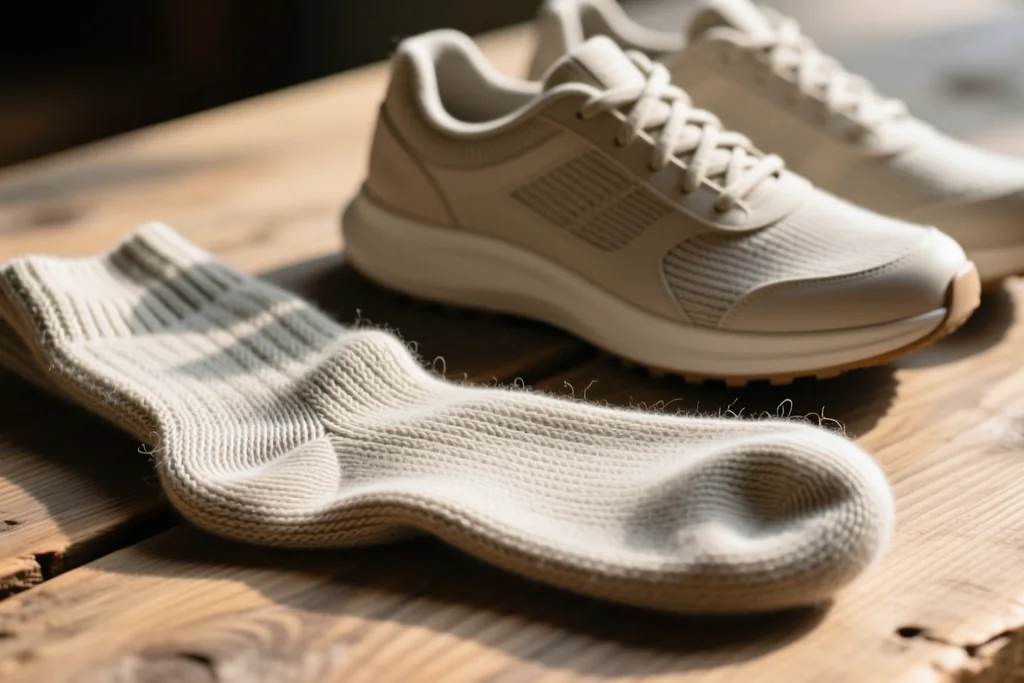
Winter running socks were covered in detail in the material comparison guide, but the key point for the layering system is that the sock is the base layer for the foot. A merino-nylon blend sock in midweight to heavyweight thickness provides the moisture management and insulation that the foot needs. The shoe is the shell — it blocks wind and protects the foot from snow and slush. For running in snow and ice, a shoe with a Gore-Tex membrane or a water-resistant upper keeps the foot dry, and added traction devices — microspikes or screw-in studs — provide grip on ice.
To help runners build a layering system that covers the full range of winter conditions, the following framework maps temperature ranges to specific layer combinations.
The combination of layers that works at -2°C will fail at -15°C, and the combination that works at -15°C will cause overheating at -2°C — which is why understanding the temperature-specific layering system is essential.
| Temperature range | Base layer | Mid-layer | Shell | Lower body | Head & hands |
|---|---|---|---|---|---|
| 5°C to 0°C | Lightweight merino or synthetic LS top | None — base layer only | Wind shell (unzipped or half-zipped) | Lightweight tights | Thin beanie + liner gloves |
| 0°C to -5°C | Lightweight merino LS top | Lightweight fleece or none | Wind shell (half-zipped) | Midweight tights | Beanie + liner gloves |
| -5°C to -10°C | Midweight merino LS top | Lightweight fleece | Wind shell (zipped, vents open) | Midweight tights with wind panel | Beanie + liner gloves + wind mitts |
| -10°C to -15°C | Midweight merino LS top | Midweight fleece or insulated vest | Wind shell (fully zipped) | Heavyweight tights with wind panel | Thick beanie + insulated gloves |
| -15°C to -20°C | Heavyweight merino LS top | Midweight fleece + insulated vest | Wind shell (fully zipped) | Heavyweight tights + wind pants | Thick beanie + insulated gloves + neck gaiter over face |
The table is a starting point, not a prescription. Every runner's thermal response is different — some runners run hot and need less insulation at every temperature, while others run cold and need more. The runner who knows their own thermal profile adjusts the table up or down by one category. The first run at each temperature range is a test — and the runner who carries one more layer than they think they need has the option to add it if the test reveals that the planned combination was insufficient.
Managing the transition: starting cold and finishing dry
The most difficult moment of a winter run is not the middle — it is the start. The body is at rest, the muscles are cold, and the clothing system is dry and at ambient temperature. The runner who is comfortable at the start of a winter run is overdressed. The runner who is slightly cold for the first five to ten minutes is dressed correctly — the body will warm up, the clothing system will trap the generated heat, and the temperature will stabilize at a comfortable level.
The warm-up should be gradual. Starting at an easy pace allows the body to generate heat without producing excessive sweat. The runner who starts fast — sprinting to get warm — generates heat quickly but also generates sweat quickly, which saturates the base layer before the system has reached equilibrium. The easy start is not just a training principle — it is a thermal management strategy.
During the run, the runner should monitor thermal balance by paying attention to the first signs of overheating or cooling. Overheating manifests as a feeling of excessive warmth, sweating that goes beyond the base layer's capacity, and a rise in breathing rate that is not explained by effort. The response is to open the shell zipper, remove a layer, or slow down. Cooling manifests as a feeling of cold, goosebumps, and a drop in breathing rate that is not explained by reduced effort. The response is to close the shell, add a layer, or increase pace.
The end of the run is the moment of maximum risk. The body stops generating heat at the moment the runner stops, but the clothing system is saturated with sweat. The wet fabric that was being ventilated by the heat of running suddenly becomes a cold, wet blanket. The runner who finishes a winter run more than five minutes from shelter should carry a dry base layer or an insulated jacket to put on immediately after stopping — because the transition from running to standing is the transition from heat generation to heat loss, and the wet clothing system accelerates that loss dramatically.
Common winter running gear mistakes
Even runners who understand the layering principle make specific mistakes that undermine the system. Identifying these mistakes is easier than correcting them after the fact, because the consequences — sweating, chilling, and cutting runs short — are unpleasant and discouraging.
Before heading out for a winter run, runners should check their gear choices against the most common mistakes that turn a well-planned layering system into a cold, wet failure.
Common winter running gear mistakes and how to avoid them:
- Dressing for the thermometer instead of the effort — the body produces 700 to 1,000 watts of heat during running. The clothing system must manage that heat, not the ambient temperature. Dress for how you will feel after ten minutes of running, not for how you feel standing at the door.
- Wearing cotton as any layer — cotton absorbs moisture and holds it against the skin, creating a wet layer that conducts heat 25 times faster than dry fabric. No cotton in any layer of a winter running system — not the shirt, not the socks, not the underwear.
- Using a waterproof shell when a wind shell would suffice — waterproof membranes restrict breathability and cause moisture buildup during high-output running. Use a wind shell for dry, cold, windy conditions. Reserve the waterproof shell for heavy precipitation.
- Over-insulating the mid-layer — the mid-layer traps heat, but too much insulation traps too much heat. A lightweight fleece is sufficient for most winter running. The runner who needs more warmth should add a vest, not a thicker fleece.
- Neglecting the extremities — cold hands and feet are not just uncomfortable; they are a sign that the body is sacrificing extremity blood flow to protect the core. Warm hands and feet start with a warm core — but they also require adequate gloves, socks, and sometimes shoe changes.
- Wearing shoes that are too tight with winter socks — thicker winter socks need more space inside the shoe. A shoe that fits perfectly with thin summer socks may be too tight with midweight merino socks, causing restricted circulation that makes the foot colder, not warmer.
- Forgetting the neck gaiter — the neck is where the major blood vessels to the brain pass close to the surface. Cold air on the neck cools the blood and makes the entire body feel colder. A neck gaiter is the highest warmth-to-weight ratio garment in the system.
- Not carrying an extra layer for the end of the run — the body stops generating heat the moment the run ends, and the wet clothing system becomes a heat loss accelerator. A dry base layer or an insulated jacket in the car or at the finish is essential for runs that end away from immediate shelter.
- Ignoring wind direction in layer selection — a headwind requires more shell protection than a tailwind. The runner who knows the wind direction can adjust the shell zipper and layer combination to match the conditions they will face, not just the conditions at the start.
- Assuming one system works for all winter conditions — winter spans a 20-degree range or more, and the system that works at -2°C fails at -15°C. The runner who builds a quiver of layers for different temperature ranges stays comfortable across the entire season.
Avoiding these mistakes is not about buying more gear — it is about using the gear correctly. The runner who has a base layer, a lightweight fleece, a wind shell, tights, gloves, and a beanie has everything needed for winter running down to -15°C. The question is not what to buy but how to combine what you have for the conditions you face — and that combination changes with every run.
Building a winter running wardrobe on a budget
The layering system does not require expensive gear. The base layer can be a budget merino top from a department store — the merino fiber performs the same regardless of the brand on the label. The mid-layer can be a basic polyester fleece from any outdoor store — the insulation properties of fleece are determined by the weight and construction, not the logo. The wind shell is the one piece worth investing in, because the fabric technology that makes a shell windproof and breathable is more expensive to manufacture and the difference between a good shell and a bad shell is more noticeable than the difference between a good fleece and a budget fleece.
The runner who is building a winter wardrobe from scratch should start with three items: a merino base layer top, a lightweight fleece, and a wind shell. These three pieces, combined with the running tights the runner likely already owns, cover the temperature range from 5°C to -5°C — which represents the majority of winter running days in most temperate climates. The runner who faces colder conditions can add a midweight fleece and an insulated vest, extending the range to -15°C without significant additional cost.
The runner's winter mindset
Winter running is not a test of toughness — it is a test of preparation. The runner who is cold is not tougher than the runner who is warm; the runner who is cold is underdressed. The runner who is sweating is not working harder than the runner who is dry; the runner who is sweating is overdressed. The layering system is the tool that makes winter running comfortable, safe, and sustainable — and the runner who masters it discovers that the best runs of the year often happen on the coldest days, when the air is crisp, the trails are empty, and the body — properly dressed, properly layered, properly managed — performs at its peak.