
Running socks guide: merino vs. nylon vs. polyester
The shoes get the attention, the GPS watch gets the data, and the socks get thrown on as an afterthought — until mile eight, when the seam across the toe starts rubbing, the heel begins slipping inside the shoe, and the moisture pooling under the arch turns a good run into a blister-management exercise. Socks are the only piece of running gear that maintains continuous, unbroken contact with the skin for the entire duration of a run. The shoe interfaces with the sock, not with the foot, and the quality of that interface determines whether the runner finishes with dry, comfortable skin or with raw, blistered spots that take a week to heal. The material the sock is made from is the single biggest factor in how it performs — bigger than the brand, the cushioning level, or the price. Merino wool, nylon, and polyester are the three materials that dominate the running sock market, and each one has a set of properties that makes it the right choice for specific conditions and the wrong choice for others.
What a running sock actually does
Before comparing materials, it helps to understand what a running sock is supposed to accomplish — because the job is more complex than "keep the foot covered." A running sock has four functions, and the material determines how well each function is performed.
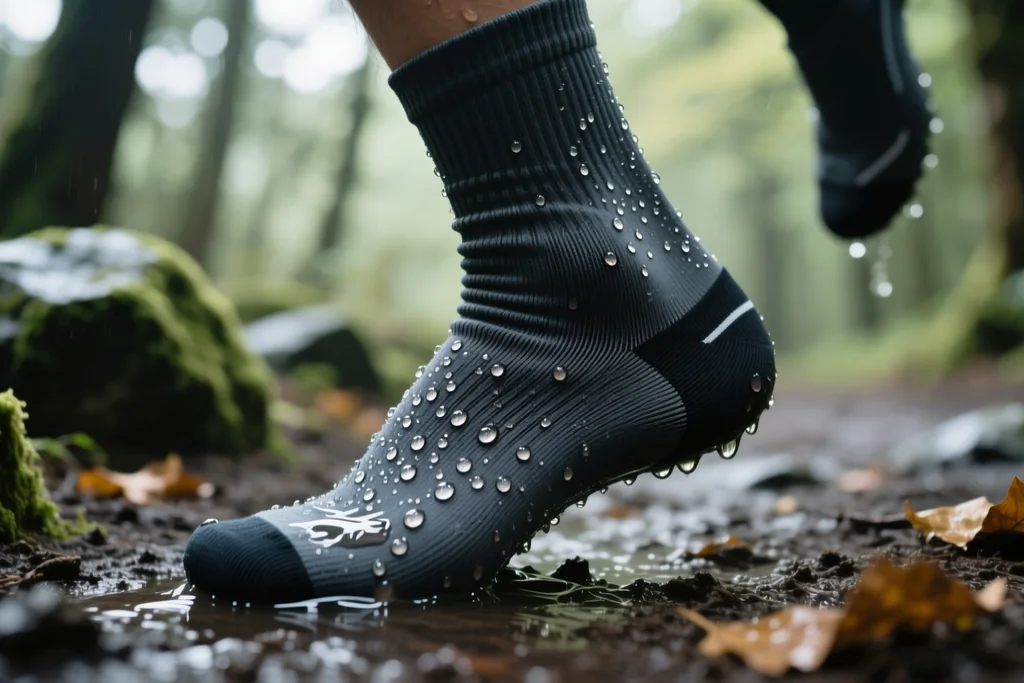
The first function is moisture management. The foot has approximately 250,000 sweat glands — more per square centimeter than almost any other part of the body — and during a run, those glands produce between 100 and 200 milliliters of sweat per foot per hour. The sock must move that moisture away from the skin and allow it to evaporate, because moisture softens the skin and soft skin blisters faster and more severely than dry skin.
The second function is friction management. Blisters are caused by shear force — the skin layers sliding against each other when the sock rubs against the foot or the shoe rubs against the sock. The sock must either reduce friction (through a smooth, tight weave that moves with the foot) or manage it (through cushioning zones that absorb the shear force before it reaches the skin).
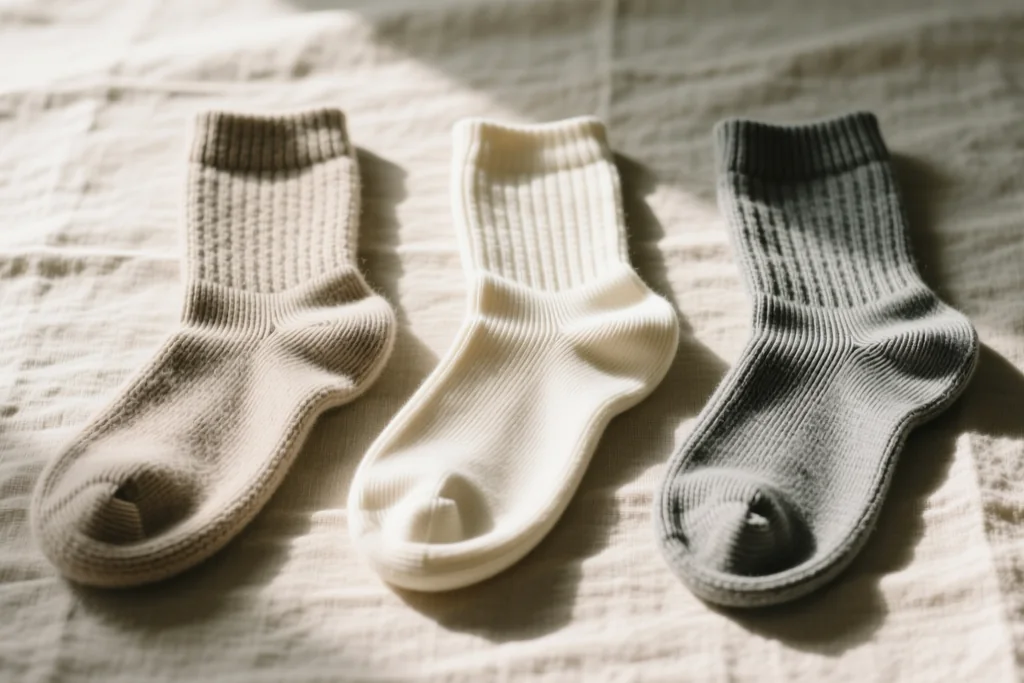
The third function is temperature regulation. The foot needs to stay warm enough that the blood vessels remain open and circulation is maintained, but cool enough that sweat evaporates rather than pools. The same sock cannot serve a January long run in Minneapolis and a July tempo session in Phoenix — but the right material can stretch the comfortable range in both directions.
The fourth function is shape retention. A running sock that stretches, bunches, or loses its shape during a run creates wrinkles that become instant blister points. The material must maintain its fit through hours of moisture, heat, and mechanical stress — returning to its original shape after each run so that it fits the same on the hundredth wear as on the first.

Merino wool: the natural fiber that runners underestimate
Merino wool comes from a breed of sheep that evolved to survive in environments ranging from freezing alpine winters to scorching summer plains. The wool fibers — which are far finer than traditional wool, measuring 15 to 24 microns in diameter — share the properties that allow the sheep to thrive in those extremes: exceptional temperature regulation, moisture absorption without feeling wet, and natural resistance to odor.
How merino manages moisture
Unlike synthetic fibers, which wick moisture by spreading it across the surface of the fiber, merino wool absorbs moisture into the interior of the fiber. The core of a merino fiber can absorb up to 35 percent of its weight in water vapor before the surface feels wet. This means that during a run, the sweat the foot produces is drawn into the fiber — away from the skin — and the surface of the sock remains relatively dry to the touch even as the fiber is working to manage the moisture.
The absorption has a secondary benefit: as the moisture is absorbed into the fiber, the fiber releases heat — a property called "heat of sorption." This is why merino feels warm when wet in cold conditions: the chemical reaction of moisture absorption generates a small but perceptible amount of heat that keeps the foot warm even when the sock is damp. No synthetic fiber replicates this property.
Temperature regulation: the merino superpower
Merino fibers are crimped — they have a natural wave that creates millions of tiny air pockets within the yarn. These air pockets trap body heat in cold conditions, providing insulation that is disproportionate to the weight of the fabric. The same crimp allows airflow in warm conditions, because the fibers do not pack flat against the skin — air circulates through the structure and carries heat away.
This dual-direction temperature regulation is what makes merino the most versatile running sock material. A lightweight merino sock (100-gram weight) can be comfortable at temperatures ranging from 5°C to 30°C — a range that no single synthetic sock can match. The runner who travels between climates, who runs early mornings that start cold and finish warm, or who wants one sock for the whole year finds merino the most practical choice.
Odor resistance: the property that matters more than runners admit
Merino wool is naturally antimicrobial. The surface of the fiber contains a waxy coating called lanolin, and the fiber structure itself absorbs the bacteria that cause odor — trapping them inside the fiber where they cannot multiply. The practical result is that merino running socks can be worn for multiple runs without developing the smell that synthetics acquire after a single use.
For runners who train daily, the odor resistance has a practical implication: fewer socks needed in the drawer, less laundry, and the ability to hang a sock to dry between runs and wear it again without anyone in the household objecting. For multi-day stage races, ultramarathon training weekends, or travel running, merino's odor resistance is not a luxury — it is a logistics solution.
The weaknesses of merino
Merino wool is not perfect, and its weaknesses matter in specific running contexts. The first is durability: merino fibers, despite being finer than traditional wool, are still natural protein fibers that are weaker than nylon or polyester. A 100 percent merino running sock will wear through at the heel and toe faster than a synthetic sock, especially under the high-friction conditions of long runs on abrasive surfaces.
The second weakness is drying time. Because merino absorbs moisture into the fiber rather than spreading it on the surface, it takes longer to dry than synthetic materials. A merino sock that gets soaked in a stream crossing or a rainstorm will remain damp for hours — whereas a polyester sock will dry in a fraction of the time. For trail running with water crossings, this is a significant disadvantage.
The third weakness is cost. Merino wool is more expensive to produce than any synthetic fiber, and merino running socks are typically two to three times the price of comparable synthetic socks. The higher cost is justified by performance and longevity of use between washes, but for a runner who goes through socks quickly due to high mileage, the expense adds up.
Nylon: the durability engine
Nylon is the strongest of the three materials commonly used in running socks, and it is rarely used alone — almost always blended with another fiber to add durability to a sock that would otherwise be too fragile. When you see a sock labeled "merino blend" or "polyester blend," the non-primary fiber is almost always nylon, and its job is to keep the sock from falling apart.
What nylon brings to the blend
Nylon fibers are exceptionally resistant to abrasion — the mechanical wearing away of a surface through friction. The heel and toe of a running sock experience thousands of high-friction impacts per run, and the fiber in those zones must resist being ground down. Nylon's abrasion resistance is three to five times that of polyester and ten times that of merino wool, which is why even socks marketed as "merino" typically have a nylon reinforcement in the high-wear zones.
Nylon also has excellent elastic recovery — the ability to stretch and return to its original shape. This is what keeps a running sock fitting snugly after hours of wear and after dozens of wash cycles. The nylon component is what prevents the sock from sagging, bunching, or losing its arch support over time. Many running socks use a small percentage of elastane or spandex for stretch, but nylon itself contributes significantly to shape retention.
The feel of nylon on the skin
Pure nylon against the skin feels smooth, almost slick — a quality that reduces friction and can be beneficial in blister prevention. However, nylon does not breathe as well as polyester or regulate temperature as well as merino. A sock made primarily of nylon would be durable but would trap heat and moisture — which is why nylon is almost always the secondary fiber rather than the primary one.
The smoothness of nylon has a downside in hot conditions: it can feel clammy against the skin when saturated with sweat, because it does not absorb moisture the way merino does or wick it as efficiently as polyester. The nylon-blend sock that feels great on a 10°C morning may feel uncomfortable on a 30°C afternoon.
Polyester: the synthetic workhorse
Polyester is the most widely used synthetic fiber in running socks, and for good reason: it is inexpensive, durable, and has excellent moisture-wicking properties. Polyester fibers can be engineered at the microscopic level — shaped, textured, and treated to optimize specific performance characteristics — which is why polyester running socks range from ultralight racing socks to heavily cushioned trail socks.
Moisture wicking: how polyester moves sweat
Polyester is hydrophobic — it does not absorb water. Instead, moisture is drawn along the surface of the fiber through capillary action, a process called wicking. The fibers are engineered with channels and grooves that increase the surface area and create pathways for moisture to travel from the skin side of the sock to the outer side, where it can evaporate. This is why a polyester sock can feel dry against the skin even during a sweaty run — the moisture has been moved away and is evaporating on the outer surface.
The wicking speed of polyester is faster than the absorption speed of merino, which means that in hot conditions where sweat production is high, polyester moves moisture away from the skin more quickly than merino can absorb it. This is the key advantage of polyester in summer running: the skin stays dry because the moisture is removed fast.
The drying advantage
Because polyester does not absorb moisture into the fiber, it dries faster than any other running sock material. A polyester sock that is soaked through — whether from sweat, rain, or a stream crossing — will dry in 30 to 60 minutes of wear, compared to 2 to 4 hours for merino. For trail runners who encounter water crossings, for runners who train in the rain, or for anyone who needs to wash socks during travel and have them dry overnight, polyester's drying speed is a decisive advantage.
The weaknesses of polyester
Polyester's main weakness is odor. The same moisture-wicking channels that move sweat away from the skin also provide an ideal environment for the bacteria that cause body odor. The bacteria colonize the fiber surface and multiply in the warm, moist environment of a running sock. After a single run, a polyester sock smells noticeably — and after a few hours in a gym bag, it smells strongly. This is the reason that many polyester running socks are treated with antimicrobial coatings, but those coatings wash out after 10 to 20 wash cycles and do not match the natural, permanent odor resistance of merino.
The second weakness is environmental. Polyester is a petroleum-derived plastic that sheds microfibers during washing — contributing to microplastic pollution. The production of polyester requires more energy and generates more greenhouse gas emissions than the production of wool. For environmentally conscious runners, the ecological footprint of polyester is a consideration — though recycled polyester, which is increasingly common in running socks, reduces the impact significantly.
To understand how the three materials compare across the performance criteria that matter most to runners, it helps to examine them side by side.
The differences between merino, nylon, and polyester become clear when evaluated against the specific demands that running places on a sock — and no single material dominates every category.
| Property | Merino wool | Nylon | Polyester |
|---|---|---|---|
| Moisture management | Absorbs into fiber (35% of weight) | Wicks on surface, moderate speed | Wicks on surface, fast speed |
| Drying time | Slow (2–4 hours when soaked) | Moderate (1–2 hours) | Fast (30–60 minutes) |
| Odor resistance | Excellent (natural, permanent) | Poor (needs antimicrobial treatment) | Poor (needs antimicrobial treatment) |
| Durability (abrasion resistance) | Low | Excellent (highest of the three) | Good |
| Temperature regulation (cold) | Excellent (insulates when wet) | Moderate | Moderate |
| Temperature regulation (heat) | Good (breathable, but absorbs moisture) | Poor (traps heat) | Good (fast wicking keeps skin dry) |
| Friction management | Good (natural smoothness of fine fibers) | Excellent (very smooth surface) | Good (engineered textures) |
| Shape retention | Moderate (can stretch with wear) | Excellent (strong elastic recovery) | Good |
| Weight when wet | Increases (absorbs water) | Moderate | Low (does not absorb water) |
| Environmental impact | Low (biodegradable, renewable) | High (petroleum-derived) | High (petroleum-derived, recyclable) |
| Cost | High (2–3× synthetic) | Low–moderate | Low |
| Best used as | Primary fiber (sole or with nylon blend) | Blend component for durability | Primary fiber (sole or with nylon blend) |
The comparison reveals that merino excels in temperature regulation, odor resistance, and comfort across a wide range — but falls short on durability and drying speed. Nylon is the durability specialist that strengthens blends but is rarely used alone. Polyester is the performance synthetic that wicks fast and dries quickly but fails on odor and environmental impact. The right sock is almost always a blend that uses the strengths of multiple materials — and the blend ratio is what determines which conditions the sock is built for.
Blends: why the best running socks are rarely 100 percent one material
The most effective running socks combine materials to maximize strengths and minimize weaknesses. A sock that is 100 percent merino is soft, warm, and odor-resistant but will wear through at the heel in 100 miles. A sock that is 100 percent polyester is durable, fast-drying, and lightweight but will smell after one run and will not regulate temperature across seasons. The blend is where engineering meets the specific needs of the runner.
The classic merino blend
The most common merino running sock is approximately 60 to 70 percent merino wool, 20 to 30 percent nylon, and 5 to 10 percent elastane or spandex. This blend preserves the temperature regulation, moisture absorption, and odor resistance of merino while adding the abrasion resistance of nylon in the high-wear zones and the stretch of elastane for a snug fit. The merino dominates the feel and performance, but the nylon extends the lifespan from 100 miles to 300 to 400 miles of use.
The ratio matters. A sock with 80 percent merino and 15 percent nylon prioritizes comfort and temperature regulation over durability — it is the sock for a runner who values feel and performance above longevity and is willing to replace socks more frequently. A sock with 50 percent merino and 40 percent nylon sacrifices some of merino's comfort for significantly more durability — it is the sock for a high-mileage runner who cannot afford to replace socks every month. Neither ratio is wrong; the choice depends on what the runner values.
The polyester-nylon blend
The most common synthetic running sock is approximately 70 to 80 percent polyester, 15 to 20 percent nylon, and 5 to 10 percent elastane. The polyester provides the wicking and drying performance, the nylon adds durability in the heel and toe, and the elastane provides the compression and fit. This blend is the workhorse of summer running, racing, and high-sweat conditions where the priority is keeping the skin dry and the sock light.
The polyester-nylon blend is also the basis for most cushioned running socks. The polyester fibers can be knitted in varying densities to create cushioning zones under the heel and forefoot — absorbing impact forces and reducing friction. The nylon in these zones ensures that the cushioning does not compress permanently and lose its function. A cushioned polyester-nylon sock is the standard for marathon training, where the combination of long miles, high impact, and high sweat production demands both protection and moisture management.
The three-way blend
Some premium running socks combine all three materials — merino for comfort and temperature regulation, nylon for durability, and polyester for wicking speed. These three-way blends are attempts to create a universal sock that performs in all conditions, and they are partially successful: a sock with 40 percent merino, 30 percent polyester, 20 percent nylon, and 10 percent elastane provides decent performance across most categories without excelling in any one. The three-way blend is the sock for the runner who wants one type of sock for everything — not the best choice for any specific condition, but a reasonable choice for all of them.
When each material works best: matching socks to conditions
The theoretical comparison of materials matters only insofar as it helps the runner choose the right sock for the conditions they actually run in. The best sock for a winter trail ultramarathon is not the best sock for a summer 5K, and understanding the match between material and condition is what turns a sock purchase from a guess into a decision.
To help runners select the right sock material for their specific running context, several factors should guide the choice based on the conditions and type of running involved.
Before choosing a running sock based on material, runners should consider the key factors that determine which material will perform best for their specific conditions and running style.
Factors to consider when choosing running sock material:
- Climate and temperature range — merino excels in cold, variable, and shoulder-season conditions where temperature regulation matters most. Polyester excels in hot, humid conditions where fast wicking and drying are critical. Nylon alone is not ideal for any climate but extends the life of both merino and polyester socks.
- Running surface and terrain — trail running on abrasive surfaces demands more nylon in the blend, regardless of whether the primary fiber is merino or polyester. Road running on smooth asphalt is less punishing and allows for lower nylon content and higher comfort fiber content.
- Expected moisture exposure — if the run involves water crossings, rain, or conditions where the sock will be soaked, polyester's fast drying time makes it the superior choice. Merino stays wet for hours and can cause blisters and discomfort in prolonged wet conditions.
- Run duration — short runs (under 60 minutes) can be done in any material because the sock does not have time to saturate. Long runs and ultra distances favor merino for odor resistance and comfort over many hours, and polyester for moisture management in hot conditions.
- Sweat rate — heavy sweaters should lean toward polyester or polyester-nylon blends, which move moisture away from the skin faster than merino can absorb it. Light sweaters can enjoy merino's comfort without the drawback of slow drying.
- Number of consecutive running days — runners who train daily and do laundry weekly benefit from merino's odor resistance, which allows a sock to be worn for multiple runs. Runners who do laundry frequently or rotate many pairs can use polyester without the odor becoming a practical problem.
- Shoe type and fit — a snug-fitting racing shoe with minimal volume works best with a thin polyester sock that does not add bulk. A roomier training shoe can accommodate a thicker merino sock that provides cushioning and warmth.
- Skin sensitivity — runners with sensitive skin or wool allergies should avoid merino despite its performance advantages. Fine merino (18-micron or less) does not itch, but some runners still react to wool proteins.
- Environmental priorities — runners who prioritize sustainability may prefer merino for its biodegradability and renewable sourcing, or recycled polyester as a compromise between performance and environmental impact.
- Budget — polyester and polyester-nylon blends are the most cost-effective option for runners who go through socks quickly. Merino is an investment that pays off in comfort and versatility but costs more upfront and may need replacement sooner due to lower durability.
These factors interact — a hot, humid, multi-day trail race with water crossings calls for polyester despite the odor issue, because the drying speed is more important than smell. A cold, dry, daily training run calls for merino because the temperature regulation and odor resistance matter more than the drying speed. The runner who understands these interactions can build a sock drawer that covers every condition they will encounter.
Caring for running socks by material
The lifespan of a running sock depends as much on how it is washed and stored as on the material it is made from. Each material has specific care requirements that preserve its performance properties and extend its functional life.
Merino wool socks require the most careful handling. Machine washing in cold water on a gentle cycle is safe for most merino running socks, but hot water can cause the fibers to felt — shrinking and matting the wool into a dense, less flexible fabric. Merino socks should be air-dried, never tumble-dried, because the heat of a dryer causes shrinkage and damages the fiber structure. The natural crimp of merino that provides temperature regulation is damaged by high heat, and once it is lost, the sock does not recover.
Polyester and nylon socks are more forgiving. They can be machine-washed in warm water and tumble-dried on low heat without significant damage. However, high heat can degrade the elastane component over time, causing the sock to lose its stretch — so low-heat drying or air drying extends the life of the elastic. Fabric softener should be avoided for all running socks, regardless of material, because it coats the fibers and reduces their ability to wick moisture — but it is especially damaging to polyester, where the wicking channels can become clogged by softener residue.
The sock drawer: building a collection that covers every run
A runner who trains year-round in varying conditions needs more than one type of sock. The ideal running sock drawer includes a mix of materials and weights that covers the full range of conditions the runner will encounter.
To build a versatile running sock collection, runners should plan their purchases around the conditions they train in most frequently and the occasional conditions that require specialized socks.
For a runner who trains in a temperate climate with four distinct seasons, the following sock collection provides coverage for every condition.
Before building a running sock collection, consider what types of socks cover the full range of training conditions a runner faces throughout the year.
Essential running socks for a year-round runner:
- Lightweight polyester-nylon socks (2–3 pairs) — for summer running, hot weather, racing, and speed workouts. The fastest wicking and drying, the lightest weight, and the best option for high-sweat conditions. Replace when the heel or toe shows visible thinning.
- Midweight merino-nylon blend socks (2–3 pairs) — for spring, autumn, and mild winter running. The most versatile sock in the drawer, covering the widest temperature range and providing odor resistance for multi-day use. The nylon blend ensures adequate durability for regular training.
- Heavyweight merino-nylon blend socks (1–2 pairs) — for cold winter running and early morning runs in freezing conditions. Maximum insulation, maximum cushioning, and the warmth-when-wet property that makes merino irreplaceable in cold, wet conditions.
- Trail-specific socks with reinforced nylon (1–2 pairs) — for off-road running where debris, water, and abrasive surfaces demand maximum durability. These socks typically have a higher nylon content, tighter weave, and sometimes a debris cuff that prevents grit from entering the sock.
- Compression socks (1 pair) — for recovery and travel, not for running. Compression socks improve venous return and reduce swelling after long runs or races. The material is typically a polyester-nylon blend with high elastane content for graduated compression.
This collection covers every condition from a July track session to a January trail run, with enough pairs to rotate through a week of training without running out of clean socks or wearing the same pair twice in a row — which gives each pair time to dry fully and recover its shape between uses. The investment is modest compared to the cost of shoes and other gear, and the difference in comfort and blister prevention is immediate and significant.
The bottom line on running sock materials
The material of a running sock is not a marketing detail — it is the primary determinant of how the sock performs. Merino wool is the comfort champion, the temperature regulator, and the odor fighter, with the trade-off of lower durability and slower drying. Nylon is the durability additive that extends the life of any blend, with the trade-off of poor breathability when used alone. Polyester is the moisture manager and the quick-drying specialist, with the trade-off of odor and environmental impact. The runner who matches the material to the condition — merino for cold and variable, polyester for hot and wet, nylon as the reinforcing component in both — eliminates a variable that causes more blisters, more discomfort, and more frustration than any other piece of running gear. The shoes carry the runner, but the socks carry the feet — and the feet are where every run begins and ends.