Tight calves? 5 stretches that work without pain
You wake up, plant your feet on the floor, and the first step feels like stepping onto a trampoline strung too tight — the calves burn, the heels resist, the achilles pulls. By the third step, it eases. By the tenth, you have forgotten about it. But the tightness has not gone anywhere; it has simply been buffered by movement, and it will return the next morning, and the morning after that, accumulating quietly until one day it does not ease — it sharpens, and what was tightness becomes a strain, a tear, or an achilles that has had enough. Tight calves are the most universal complaint in running, and also the most poorly addressed. The typical response — a ten-second wall stretch before a run, a quick tug of the towel afterward — is so insufficient that it barely registers as intervention. The calves are not tight because they are short; they are tight because they are overworked, under-recovered, and caught in a neurological pattern that no quick stretch will break. Loosening them requires understanding why they tightened in the first place, choosing stretches that target the right tissue at the right intensity, and holding those stretches long enough for the nervous system to actually let go.
Why runners' calves get tight in the first place
The calf complex — primarily the gastrocnemius and the soleus, with the achilles tendon connecting them to the heel — is one of the most heavily loaded muscle groups in running. With each step, the calf absorbs forces of two to three times body weight as the foot lands and the ankle dorsiflexes. It then contracts eccentrically to control the descent of the heel, and concentrically to propel the body forward. Over a five-kilometer run, a runner takes approximately 2,500 steps — meaning each calf absorbs and produces roughly 5,000 high-force contractions. The calf is working harder than any other muscle group in running, yet it receives less recovery attention than the quads, the hamstrings, or the glutes.
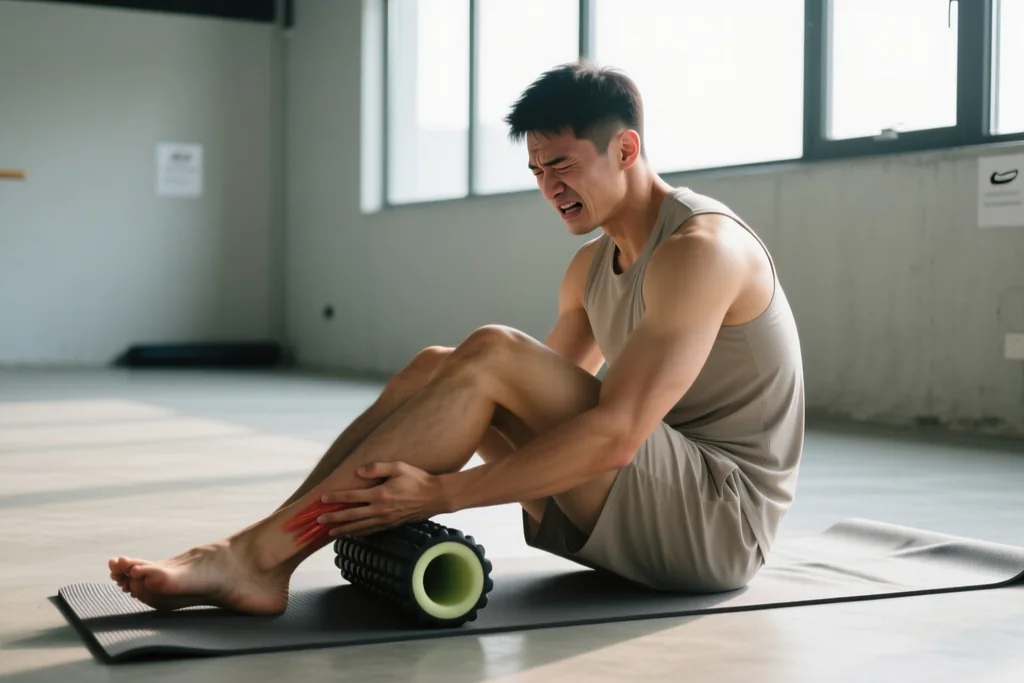
Tightness develops through three mechanisms that often operate simultaneously. The first is protective tone — the nervous system increases the baseline activation of the calf to protect the achilles tendon from damage. When the tendon is stressed by training volume, the body responds by tightening the muscle to limit the range of motion that loads the tendon. The tightness is not the problem; it is the body's solution to a different problem (tendon stress). Stretching alone does not address the underlying tendon issue, and in some cases, aggressive stretching of a protective pattern can make things worse.
The second mechanism is adaptive shortening. When a muscle is held in a shortened position for extended periods — as happens when a runner sits with bent knees and plantarflexed ankles, or wears shoes with an elevated heel that keeps the calf in a shortened position — the muscle fibers and fascia adapt to that position by reducing their resting length. The calf that spends eight hours a day in a shortened position does not return to full length during a thirty-minute run; it starts the run shortened and stays shortened.
The third mechanism is fascial restriction. The connective tissue that surrounds the calf muscles — the fascia — becomes dense and less mobile in response to repeated loading and insufficient recovery. Unlike muscle tissue, which responds to stretch by lengthening, fascia responds to sustained pressure and heat. Stretching the fascia requires longer holds — thirty seconds is not enough; two to three minutes is the minimum for fascial release — and most runners do not hold their calf stretches long enough to affect the fascia at all.
The difference between gastrocnemius and soleus tightness
One of the reasons calf stretches fail is that most runners do not distinguish between the two muscles of the calf complex — and the two muscles require different stretches because they attach to the skeleton at different points.
The gastrocnemius is the visible, bulging muscle of the calf. It originates above the knee on the femur and inserts into the achilles tendon at the heel. Because it crosses the knee joint, the gastrocnemius is affected by knee position: when the knee is straight, the gastrocnemius is stretched; when the knee is bent, it is slackened. A straight-leg stretch targets the gastrocnemius.
The soleus sits beneath the gastrocnemius and is not visible from the surface. It originates below the knee on the tibia and fibula and inserts into the same achilles tendon. Because it does not cross the knee joint, the soleus is not affected by knee position: it is stretched regardless of whether the knee is straight or bent. In fact, bending the knee during a calf stretch slackens the gastrocnemius and isolates the soleus — which is critical, because the soleus is often the tighter of the two in runners, since it bears more of the load during running than the gastrocnemius.
The practical implication is that a complete calf stretching routine must include both straight-leg and bent-knee stretches. A routine that only includes straight-leg stretches addresses the gastrocnemius but leaves the soleus untouched — and the soleus is the muscle that is most likely to be the source of the tightness.
How long to hold a stretch for it to actually work
The duration of a stretch is the variable that most runners get wrong. A ten-second stretch produces a sensory experience — the muscle feels stretched — but it does not produce a meaningful change in tissue length or muscle tone. The nervous system needs time to register the stretch as safe before it reduces the protective tension that causes tightness.
The research on stretch duration points to a clear pattern: holds of less than fifteen seconds produce minimal change in range of motion. Holds of thirty seconds produce moderate change. Holds of sixty seconds or more produce the greatest change — and holds of two to three minutes begin to affect the fascia, not just the muscle. The runner who holds a calf stretch for ten seconds and repeats it three times gets less benefit than the runner who holds the same stretch for ninety seconds once.
For a calf stretching routine that targets both the muscle and the fascia, each stretch should be held for a minimum of thirty seconds, with sixty to ninety seconds being the target for chronic tightness. The stretch should be felt as a moderate pulling sensation — not pain, not burning, not a sensation that makes the body want to recoil. The intensity that produces lasting change is the intensity that the nervous system can tolerate without increasing protective tension.
The five stretches
The following five stretches were selected because each targets a different aspect of the calf complex and can be performed without equipment beyond a wall, a step, a towel or resistance band, and a floor. Together, they address the gastrocnemius, the soleus, the achilles tendon, the fascia, and the neural mobility of the leg.
1. The wall stretch — straight leg for gastrocnemius
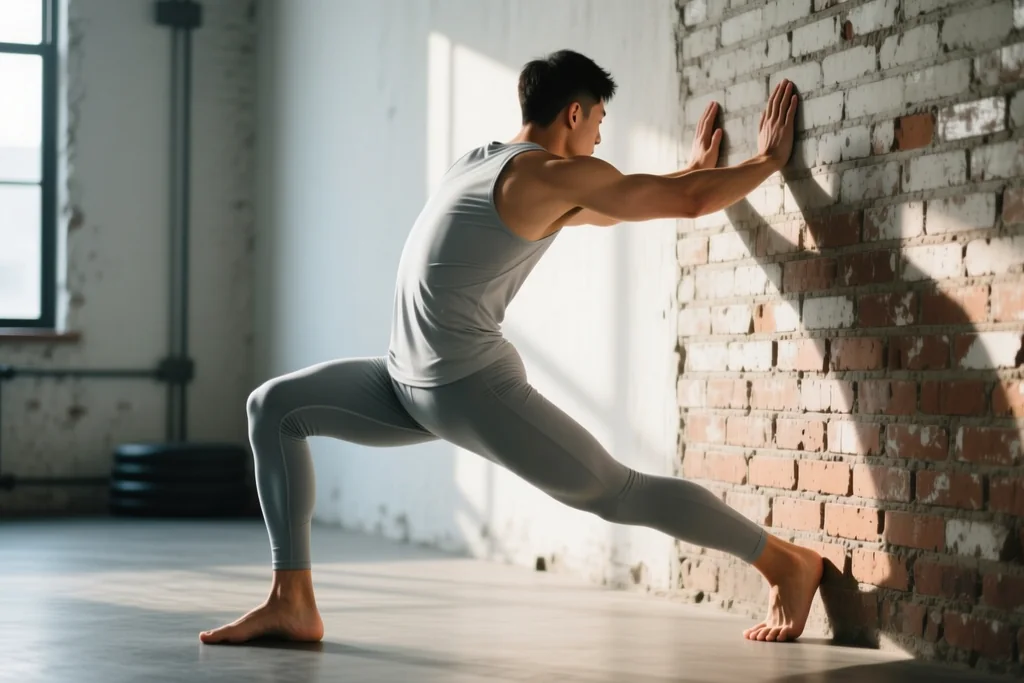
Stand facing a wall, approximately one meter away. Place both hands on the wall at shoulder height. Step one foot forward, bending the front knee, and keep the back leg straight with the heel flat on the floor. The back foot should point straight forward — not turned out, which is the most common mistake and which shifts the stretch from the calf to the outer ankle. Lean into the wall by bending the front knee and shifting the hips forward, keeping the back leg straight and the back heel grounded. The stretch should be felt in the belly of the calf muscle on the back leg — not at the achilles, not behind the knee, not in the arch of the foot.
The key to this stretch is keeping the heel down. As the body leans forward, the heel wants to lift — and when it lifts, the stretch is lost. The runner who feels nothing in the wall stretch is almost certainly letting the heel rise. To prevent this, shorten the stance and reduce the lean until the heel stays down and the stretch is felt in the calf. The intensity should be moderate — a five or six out of ten — and should not increase during the hold. If the intensity increases, the body is tightening in response to the stretch, and the intensity should be reduced.
Hold for sixty seconds per side. The long hold is what distinguishes this from the ten-second version that most runners perform — and it is the long hold that produces lasting change.
2. The wall stretch — bent knee for soleus
From the same position as the straight-leg wall stretch, simply bend the back knee while keeping the heel down. The bent knee slackens the gastrocnemius and shifts the stretch to the soleus, which is the deeper muscle and the one that bears most of the running load. The sensation will be different — deeper, less sharp, and located lower in the calf, closer to the achilles. The bent-knee version often produces a more intense stretch than the straight-leg version, despite feeling less dramatic, because the soleus is typically tighter than the gastrocnemius in runners.
The same principles apply: the back foot points forward, the heel stays down, the intensity is moderate. The bent knee does not need to bend deeply — a slight bend, enough to feel the shift in the stretch location, is sufficient. The common mistake is bending the knee so much that the stretch disappears, which happens when the knee bends past the point where the soleus is engaged.
Hold for sixty seconds per side. Because the soleus is often the primary source of tightness, this stretch may be the most important of the five — and it is the one that most runners never do.
3. The eccentric heel drop — for calves and achilles
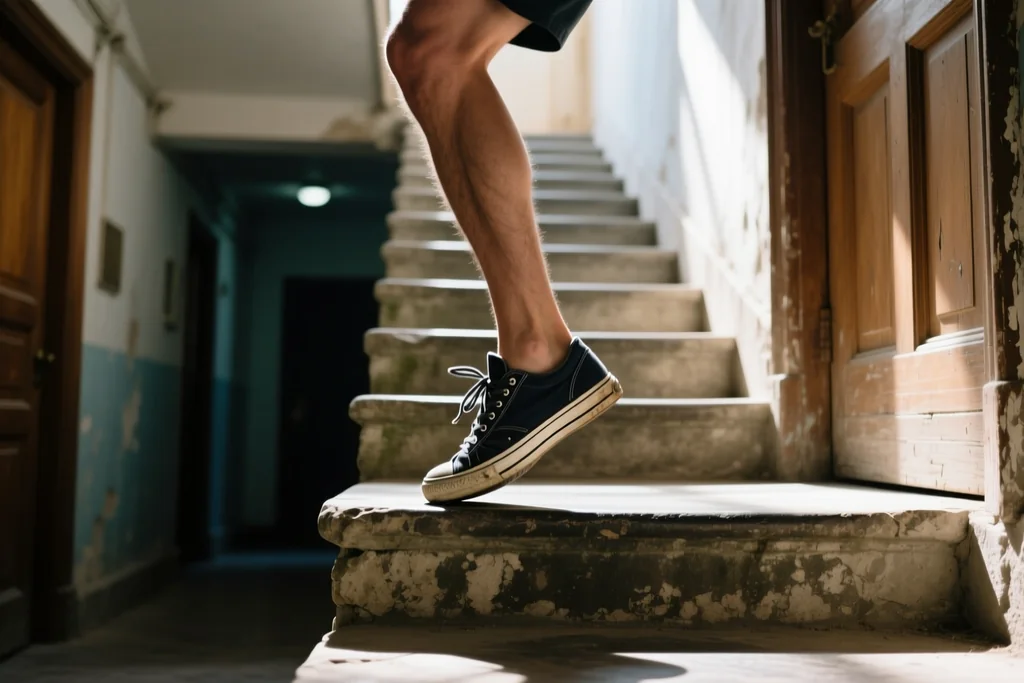
Stand on the bottom step of a staircase, or on a curb, or on a raised platform, with the balls of the feet on the edge and the heels hanging off. Rise onto the toes of both feet (concentric phase), then shift the weight to one foot and slowly lower the heel of that foot below the level of the step (eccentric phase), using the other foot to return to the starting position. The lowering should take three to four seconds — slow enough that the calf is controlling the descent, not just dropping.
The eccentric heel drop is not a traditional stretch — it is a strengthening exercise that also improves the flexibility and resilience of the calf and achilles. Eccentric loading — the controlled lengthening of a muscle under tension — is the most effective intervention for both tight calves and achilles tendinopathy, because it simultaneously stretches the tissue and strengthens it. Unlike passive stretching, which only addresses length, eccentric loading addresses the capacity of the tissue to handle load at longer lengths — which is what running demands.
The eccentric heel drop should be performed with the knee straight (targeting the gastrocnemius) and with the knee slightly bent (targeting the soleus). Three sets of fifteen repetitions per side, with a three-second lowering phase, is the standard protocol. This is the one exercise in the routine that produces fatigue — and the fatigue is the point, because it is the fatigue that drives the adaptation that makes the calf more resilient.
4. The towel stretch — for first-thing-in-the-morning tightness
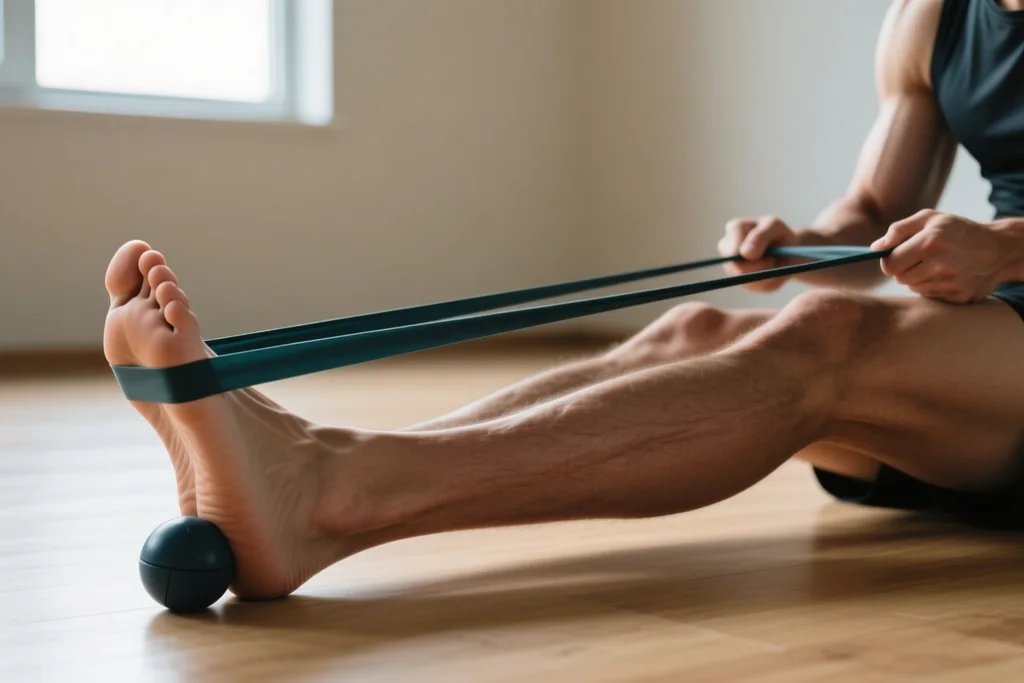
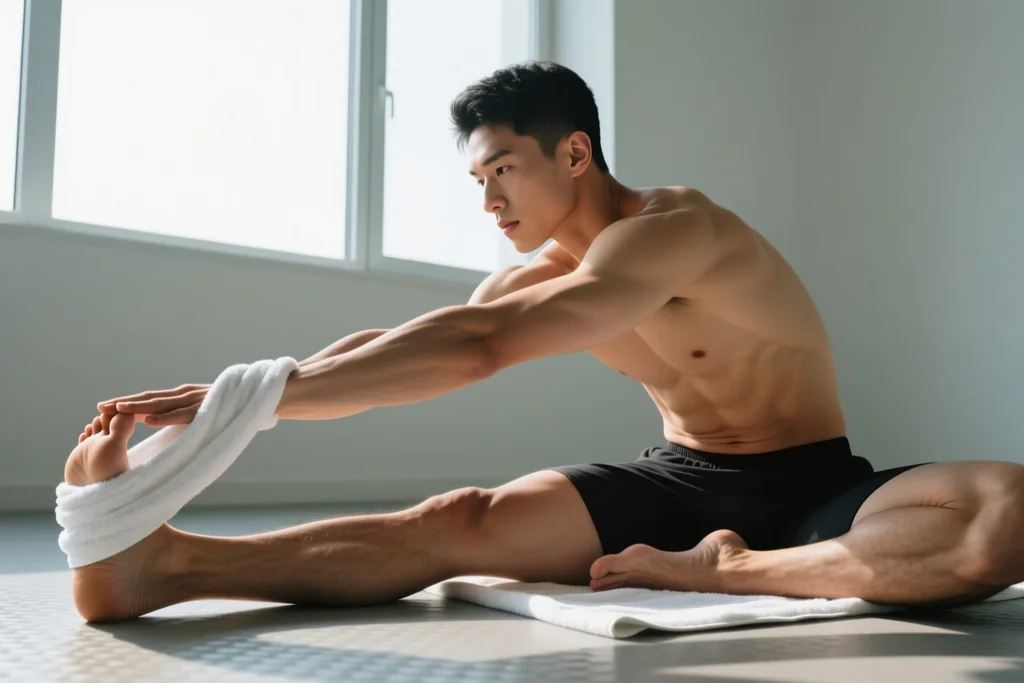
Sit on the floor with both legs extended. Loop a towel, resistance band, or belt around the ball of one foot. Keeping the knee straight, pull the towel toward the body, dorsiflexing the ankle (pulling the toes toward the shin). The stretch should be felt in the calf and, if the band is pulled more aggressively, along the entire back of the leg into the hamstring. The intensity is controlled entirely by the hands — the runner can adjust the pull in real time, which makes this the most precise stretch for finding the right intensity.
The towel stretch is particularly valuable for morning tightness, when the calves are cold and the body is stiff. It can be performed in bed before getting up — sitting with the legs extended, looping a band around the foot, and gently pulling. The gentle, controlled dorsiflexion prepares the calves and achilles for the first steps of the day, reducing the jarring sensation that tight calves produce on the first steps out of bed.
For runners with very tight calves, the towel stretch is also the best diagnostic tool. If pulling the toes toward the shin produces a stretch in the calf, the limitation is muscular. If pulling produces a stretch that radiates down the leg into the foot, or if the stretch is limited not by tightness but by a pinching sensation in the front of the ankle, the limitation may be joint mobility — not muscle — and stretching alone will not resolve it. This distinction matters because a runner can stretch tight calves for months without improvement if the real limitation is ankle joint mobility, and identifying that early saves months of frustration.
Hold for sixty to ninety seconds per side. The longer hold is possible because the intensity is self-regulated — the runner can ease off or increase the pull as the muscle relaxes.
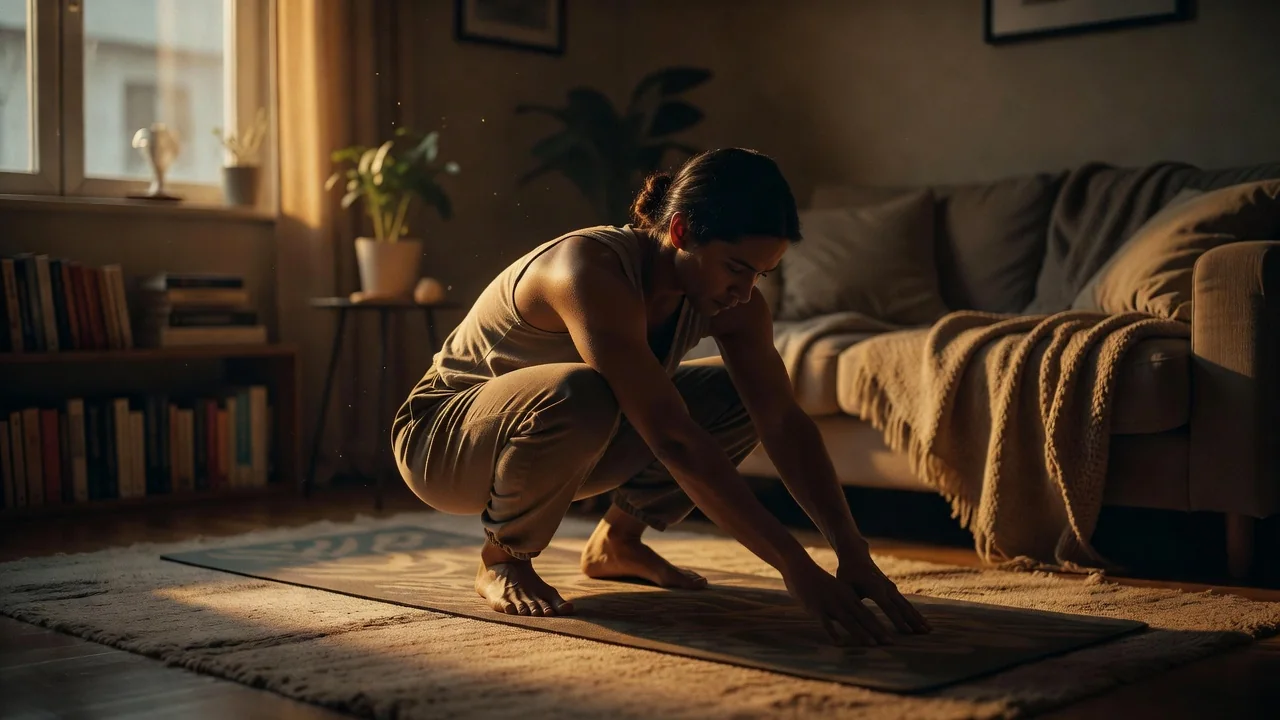
5. Downward dog — for integrated posterior chain mobility
Start on the hands and knees on a yoga mat. Tuck the toes under and lift the hips toward the ceiling, straightening the legs to form an inverted V. Press the heels toward the floor — they do not need to touch the floor, but the effort of pressing down is what stretches the calves. Keep the spine long and the shoulders relaxed away from the ears.
The downward dog is included because it stretches the calf in a position that integrates the entire posterior chain — the calves, hamstrings, glutes, and back are all engaged in a single position. This integration matters because the calf does not function in isolation during running; it works as part of a chain that extends from the foot to the spine. Stretching the calf in isolation improves local mobility, but stretching it within the context of the full chain improves the coordination of the chain — which is what running actually demands.
The downward dog also allows dynamic stretching — pedaling the heels alternately toward the floor, which moves the stretch between the left and right calf and introduces movement into the stretch. Dynamic stretching within a held position is more functional than static stretching alone, because it trains the muscle to function at longer lengths while moving — which is closer to what running demands.
To address both muscles of the calf, perform the downward dog with straight legs (gastrocnemius) and then with slightly bent knees (soleus), pedaling the heels in each position. Hold each variation for thirty to sixty seconds, alternating between straight and bent knees two to three times.
Common mistakes that make calf stretching ineffective
Understanding what to do is only half the battle — knowing what to avoid is equally important. The following mistakes are the most common reasons that runners stretch their calves religiously and see no improvement.
Before adding these stretches to a routine, runners should be aware of the most common mistakes that turn a well-intentioned stretching practice into a waste of time.
Common calf stretching mistakes:
- Holding for less than 30 seconds — the nervous system needs sustained pressure to reduce protective tone. Ten-second stretches feel productive but produce almost no lasting change in muscle length or tone.
- Stretching to the point of pain — pain triggers protective tension, which is the opposite of what stretching is supposed to achieve. The stretch should be uncomfortable but not painful — a sensation the body can relax into, not one it wants to escape from.
- Letting the heel lift during wall stretches — the moment the heel rises, the stretch is gone. Reducing the stretch intensity to keep the heel down is always more effective than increasing the intensity and losing the heel.
- Turning the back foot outward — outward rotation shifts the stretch from the calf to the lateral ankle and removes the stretch from the gastrocnemius and soleus. The foot must point straight forward.
- Only stretching with a straight knee — straight-leg stretches target the gastrocnemius but miss the soleus, which is often the tighter muscle. Both straight-leg and bent-knee stretches are necessary.
- Stretching cold muscles — cold tissue is less pliable and more likely to trigger protective tension. Stretching after a run, after a warm-up, or after a hot shower is more effective than stretching first thing in the morning on cold muscles.
- Bouncing in the stretch — ballistic stretching (bouncing to push deeper into the stretch) triggers the stretch reflex, which causes the muscle to contract against the stretch. The stretch should be static — held still at a consistent intensity.
- Ignoring the soleus — the soleus bears more load during running than the gastrocnemius and is typically tighter. A routine that only includes straight-leg stretches misses the muscle that needs the most attention.
- Stretching but not strengthening — stretching alone does not improve the calf's capacity to handle load at longer lengths. Eccentric strengthening (heel drops) is what builds the resilience that prevents the tightness from returning.
- Not addressing footwear — shoes with an elevated heel keep the calf in a shortened position throughout the day, undoing the work of stretching. Daily footwear with a lower heel drop supports the gains from stretching.
Avoiding these mistakes does not require more time or effort — it requires doing the same things differently. The runner who corrects these errors without adding a single minute to their routine will see more improvement than the runner who adds twenty minutes of incorrect stretching.
How to structure a calf stretching routine
A calf stretching routine that actually produces results requires more than a list of stretches — it requires a structure that addresses the muscles in the right order, with the right duration, and at the right time. The following framework organizes the five stretches into a sequence that takes ten to fifteen minutes and can be performed after every run.
The order of the stretches matters because each stretch prepares the tissue for the next. Starting with the gentler stretches and progressing to the more intense ones allows the nervous system to gradually reduce protective tension, making each subsequent stretch more effective than it would be if performed cold. Ending with the eccentric strengthening exercise ensures that the flexibility gains are backed by the strength that makes them durable.
To put the five stretches into practice, the following sequence organizes them into a routine that takes 10 to 15 minutes and addresses both muscles of the calf complex.
The routine should be performed after running or after a warm-up, when the tissue is most responsive. Each stretch should be held at a moderate intensity — never painful — and the sequence should be repeated on both legs.
Calf stretching routine sequence:
- Towel stretch — 60 seconds per leg — start with the gentlest stretch to introduce dorsiflexion to the nervous system. The self-regulated intensity allows the runner to find the right level of stretch without triggering protective tension. This stretch prepares the calf for the more intense stretches that follow.
- Wall stretch, straight leg — 60 seconds per leg — with the calf warmed up by the towel stretch, the straight-leg wall stretch targets the gastrocnemius with a moderate, sustained stretch. Keep the heel down and the foot pointing forward.
- Wall stretch, bent knee — 60 seconds per leg — immediately after the straight-leg version, bend the knee to shift the stretch to the soleus. The transition from straight to bent knee is seamless and targets the deeper muscle while the gastrocnemius is still relaxed from the previous stretch.
- Downward dog — 60 seconds, alternating straight and bent knees — the integrated stretch addresses the full posterior chain and introduces dynamic movement through heel pedaling. The transition from isolated stretches to an integrated position helps the nervous system coordinate the chain that running demands.
- Eccentric heel drops — 3 sets of 15 reps per leg — finish with strengthening. The eccentric loading converts the flexibility gains into functional capacity by training the calf to handle load at longer lengths. This is the exercise that prevents the tightness from returning, because it addresses the weakness that caused the tightness in the first place.
This sequence takes approximately twelve to fifteen minutes and covers all the bases: gentle introduction, gastrocnemius stretch, soleus stretch, integrated chain stretch, and eccentric strengthening. Performed three to four times per week, this routine produces measurable improvement in calf mobility within two to three weeks and significant improvement within six to eight weeks.
When tight calves are not just tight calves
Sometimes the calf stretching routine does not work — not because the stretches are wrong, but because the tightness is a symptom of something else. The calf that remains tight despite consistent, correct stretching is sending a signal that the problem is not in the calf but elsewhere, and the calf is compensating.
To help runners identify when tight calves are a local problem and when they are a symptom of a deeper issue, it helps to understand the most common underlying causes and how they manifest.
Tight calves can be a symptom of several underlying issues that stretching alone will not resolve, and recognizing these patterns helps runners know when to look beyond the calf for the source of the problem.
| Underlying cause | How it manifests | Why the calf tightens | What stretching does | What actually fixes it |
|---|---|---|---|---|
| Weak glutes | Calves tighten during runs, especially uphill; glutes feel inactive | Calves compensate for glutes that are not producing enough force, taking on more load than they are designed for | Provides temporary relief but tightness returns because the cause (glute weakness) is unaddressed | Glute strengthening: bridges, single-leg squats, hip thrusts |
| Limited ankle dorsiflexion (joint) | Pinching in front of ankle during stretches; calf stretches feel limited by bone, not muscle | Calf tightness is secondary to joint restriction; the muscle tightens to protect the restricted joint | Stretching the muscle does not address the joint restriction and may irritate the front of the ankle | Joint mobilization: ankle circles, dorsiflexion mobs with band, calf wall stretch with focused joint mobilization |
| Overstriding | Calves tighten during running, especially at faster paces; heel strikes far ahead of the body | Landing with the foot too far ahead of the body loads the calf eccentrically with excessive braking force, causing fatigue and tightness | Stretching provides recovery but does not prevent the running form that causes the tightness | Running form correction: increase cadence, shorten stride, land under the center of mass |
| Inappropriate shoes | Calves tighten with new shoes or after switching to lower-drop shoes | Lower heel drop places the ankle in more dorsiflexion, loading the calf more than it is accustomed to | Stretching helps but tightness persists until the calf adapts to the new shoe geometry | Gradual transition to lower-drop shoes; strengthen calves with eccentric exercises before switching |
| Achilles tendinopathy | Calf tightness with morning pain in the achilles; tenderness at the tendon | The calf tightens to protect the inflamed tendon, limiting the range of motion that loads it | Stretching can aggravate the tendon if too aggressive; gentle stretching is needed, but the tendon is the primary issue | Eccentric heel drops (the protocol that has clinical evidence for achilles tendinopathy); reduced training load; professional assessment |
The patterns in the table share a common thread: the calf is almost never the root cause of its own tightness. It is the messenger — the tissue that tightens because something else is not doing its job, whether that something is the glutes, the ankle joint, the running form, or the shoes. The runner who stretches religiously and sees no improvement should look beyond the calf for the source — because the calf is where the symptom lives, not where the problem starts.
How long does it take to see improvement
The timeline for improvement depends on how long the tightness has been present and what is causing it. A runner with acute tightness from a recent increase in training volume can expect significant improvement within two to three weeks of consistent stretching and eccentric strengthening. A runner with chronic tightness that has been present for months or years will need longer — six to twelve weeks — because the fascial restriction and the neural patterns that maintain the tightness are more deeply established.
The key variable is consistency. A fifteen-minute routine performed four times per week produces more improvement than a thirty-minute routine performed once per week. The nervous system responds to repeated, consistent stimulus — not to occasional intense intervention. The runner who makes calf mobility a daily habit, even if that habit is only five minutes of the routine on busy days, will see faster and more lasting improvement than the runner who does a full routine sporadically.
Improvement should be measured not by how the calf feels during stretching, but by how it feels during running and in the morning. The first sign of improvement is reduced morning stiffness — the first steps out of bed feel less jarring. The second sign is reduced tightness during running, especially at the end of long runs. The third sign, which takes the longest to appear, is increased ankle dorsiflexion range of motion, which can be measured by the knee-to-wall test: standing facing a wall, place the foot a set distance from the wall, and see how far the knee can bend forward to touch the wall without the heel lifting. An increase of one to two centimeters in this distance over six to eight weeks indicates real improvement in calf and ankle mobility.
The calf is not the enemy
Tight calves are not a nuisance — they are a signal. They tell the runner that the calf is doing more work than it can recover from, that something in the training, the form, or the equipment is placing excessive load on the tissue, and that the body is responding the only way it knows how: by tightening up to protect itself. The stretching routine addresses the symptom — the tightness — and the eccentric strengthening addresses the capacity — the calf's ability to handle the load. But the lasting solution requires listening to what the tightness is saying: that the calves need support, not just from stretching, but from stronger glutes, better running form, appropriate shoes, and a training progression that respects the calf's recovery capacity. The runner who stretches, strengthens, and listens discovers that the calves are not the enemy — they are the ally that has been holding the body together, and they loosen up the moment the runner starts giving them what they actually need.