
Foam rolling mistakes runners make and how to fix them
The foam roller sits in the corner of the bedroom, half-hidden under a pile of running gear, used twice in the last month — both times after a hard workout, both times for about four minutes, both times with a level of pressure that made the eyes water and the breath catch. The runner rolls the IT band like they are trying to flatten dough, spends thirty seconds on each leg, and walks away believing they have done recovery work. They have not. What they have done is inflict pain on tissue that is already irritated, in a direction and with a force that does not produce any of the adaptations that foam rolling is supposed to trigger. Foam rolling is one of the most accessible, most affordable, and most misunderstood recovery tools available to runners. The gap between what runners think it does and what it actually does is wide enough that millions of athletes are rolling incorrectly — not dangerously, in most cases, but certainly not effectively. The result is wasted time, unnecessary pain, and missed recovery benefits that could be achieved with the same tool, the same amount of time, and a fundamentally different approach.
What foam rolling actually does to your muscles
The popular belief is that foam rolling "breaks up knots" or "releases tight muscles" — mechanical metaphors that imagine the roller as a tool that physically remodels tissue the way a rolling pin flattens pastry. This model is wrong, and understanding why it is wrong is the first step to rolling correctly.
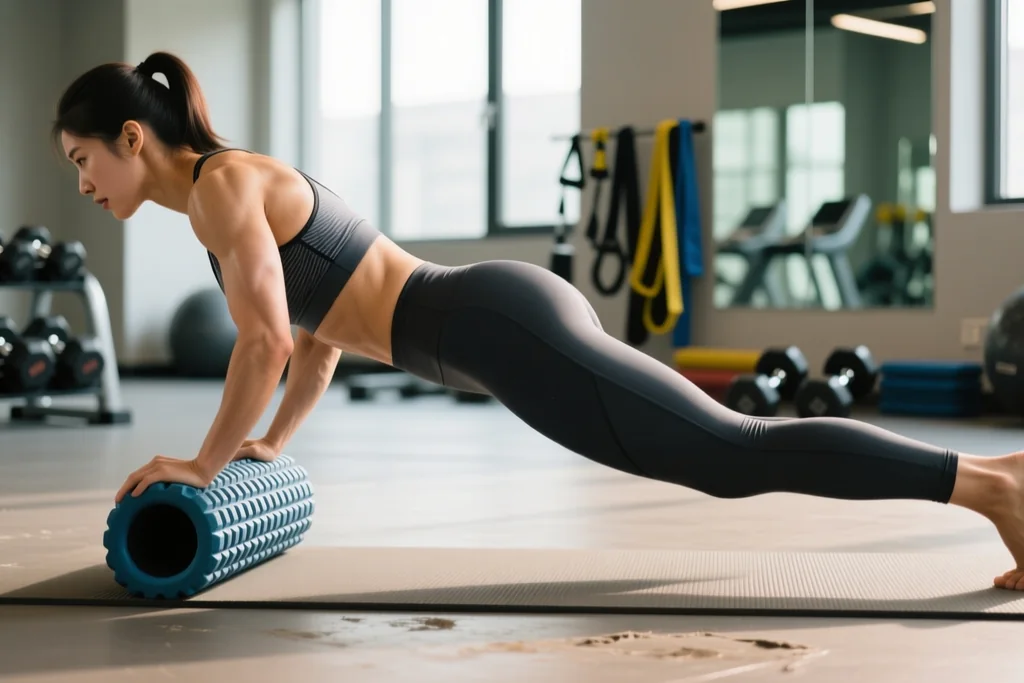
Muscle tissue does not contain "knots" in the literal sense. What runners feel as tightness, tenderness, or a "knot" is typically a combination of increased muscle tone (the baseline level of activation in the muscle), fascial restriction (reduced mobility of the connective tissue that surrounds the muscle), and sensitization of the nervous system (the brain's interpretation of signals from the area as discomfort). The foam roller does not mechanically break apart adhesions or scar tissue — the forces required to deform connective tissue mechanically are far greater than what body weight on a foam roller can generate, and applying such forces would cause tissue damage.
What the foam roller actually does is stimulate mechanoreceptors — sensory receptors in the skin, fascia, and muscle that respond to pressure and stretch. When these receptors are stimulated, they send signals to the nervous system that reduce the level of muscle tone in the area being rolled. The effect is neurological, not mechanical: the brain receives the signal that the area is being pressured in a controlled way, and it responds by reducing the protective tension it has been maintaining. This is why foam rolling works — and why the force of the pressure matters less than the quality and duration of the stimulus.
A secondary effect is increased blood flow to the area. The pressure of the roller compresses blood vessels, and when the pressure is released, blood rushes back into the tissue, bringing oxygen and nutrients and removing metabolic waste products. This vascular flushing accelerates the recovery of muscles that have been damaged by the eccentric loading of running.
The third effect is improved perception of mobility. Studies consistently show that foam rolling increases range of motion without decreasing muscle performance — unlike static stretching, which can temporarily reduce force production. The mechanism is likely a combination of reduced muscle tone and altered perception of stretch tolerance: the nervous system becomes more comfortable with the range of motion after the rolling stimulus.
Mistake 1: Rolling too fast
The most universal mistake runners make with the foam roller is speed. The leg is rolled from ankle to hip in five seconds — a rapid pass that feels like work because the roller is moving over tender tissue, but that produces almost none of the effects that foam rolling is designed to achieve.
The mechanoreceptors that respond to foam rolling need sustained pressure to signal the nervous system effectively. A rapid pass stimulates the receptors briefly, but the signal is too short to trigger the neurological response that reduces muscle tone. The analogy is a massage: a therapist who strokes the muscle once and moves on does not produce the same effect as one who holds pressure on a tender point for thirty to sixty seconds. The sustained pressure is what communicates "this area is safe to relax" to the nervous system — and that communication takes time.
The correct speed is approximately one to two centimeters per second. A full pass along the quadriceps, from hip to knee, should take twenty to thirty seconds. When the roller encounters a particularly tender spot — a "trigger point" or area of heightened sensitivity — the roller should pause and hold pressure on that spot for thirty to sixty seconds, or until the tenderness begins to decrease. This sustained pressure is where the neurological effect happens, and skipping it is the difference between rolling and recovering.
Mistake 2: Rolling directly on the IT band
The iliotibial band — the thick band of connective tissue that runs down the outside of the thigh from the hip to the knee — is one of the most commonly rolled areas in runners, and it is also the area where rolling is most often counterproductive. The IT band is not a muscle — it is a tendon-like structure made of dense connective tissue that has minimal blood supply and no contractile capacity. Rolling directly on the IT band does not "release" it because the IT band cannot be released by pressure — its tension is determined by the muscles that attach to it, not by the band itself.
What runners experience as IT band tightness is usually tension transmitted from the tensor fasciae latae (a small muscle at the hip) and the gluteus maximus, both of which feed into the IT band. When these muscles are tight, the IT band feels tight — but rolling the band itself does nothing to address the source. The correct approach is to roll the muscles that attach to the IT band — the TFL at the hip and the glutes — and to use the roller on the lateral quadriceps, which sit just in front of the IT band and are often the actual source of the lateral thigh pain that runners attribute to the band.
Rolling directly on the IT band is not only ineffective but can be painful and counterproductive. The pressure on the band compresses it against the underlying bone (the femur), which can irritate the tissue and increase inflammation — making the problem worse, not better. The runner who spends ten minutes grinding the IT band on a foam roller is increasing irritation without increasing recovery.
Mistake 3: Rolling the lower back
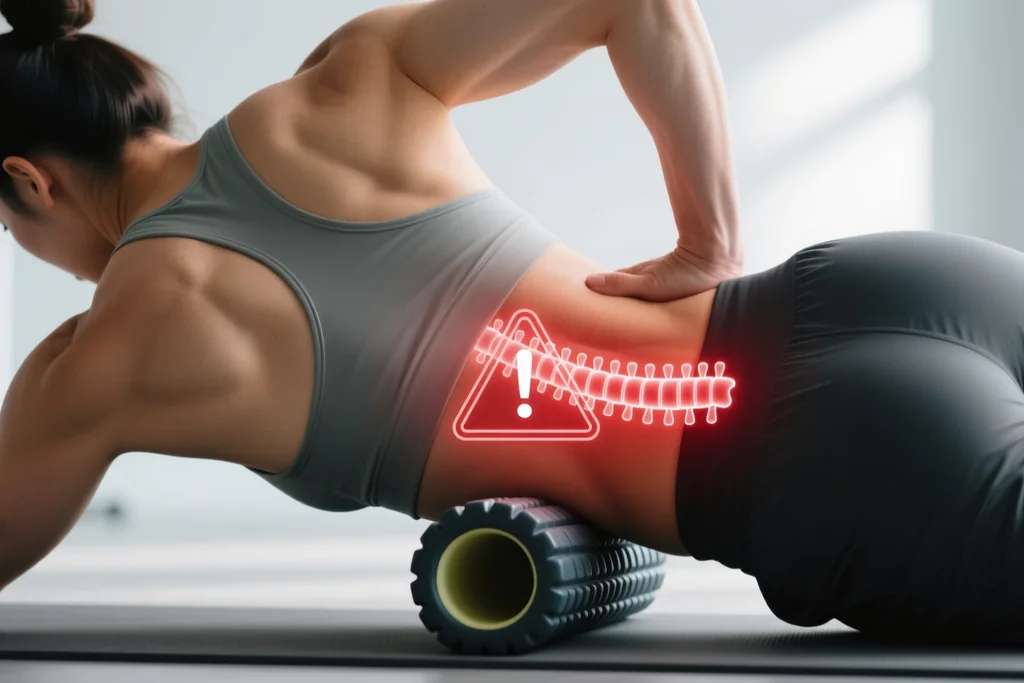
The lower back is the area where foam rolling transitions from ineffective to potentially harmful. The lumbar spine is supported by thin layers of muscle — the erector spinae — that sit close to the spinal column and that do not benefit from the broad, heavy pressure of a standard foam roller. When a runner places the roller under the lower back and rolls, the pressure is applied not to the muscles but to the spinal column itself, with the organs of the abdominal cavity compressed between the spine and the roller.
The lower back muscles do not need foam rolling because they are rarely the source of running-related tightness. The tightness that runners feel in the lower back is typically referred from the glutes, the hip flexors, or the thoracic spine — all of which can be safely rolled, unlike the lumbar spine. If a runner feels tension in the lower back, the solution is to roll the surrounding areas — the glutes, the hip flexors, the upper back — and to stretch the hip flexors, which are the most common hidden cause of lower back tension in runners.
The thoracic spine — the upper and mid-back — is safe to roll and benefits from it. The muscles in this area are thicker, the ribs provide structural support, and the mobility of the thoracic spine is often restricted in runners who spend hours in a forward-leaning position. Rolling the thoracic spine with the foam roller perpendicular to the spine, from the base of the neck to the bottom of the rib cage, improves thoracic extension and reduces the compensatory strain on the lower back.
Mistake 4: Using the wrong density
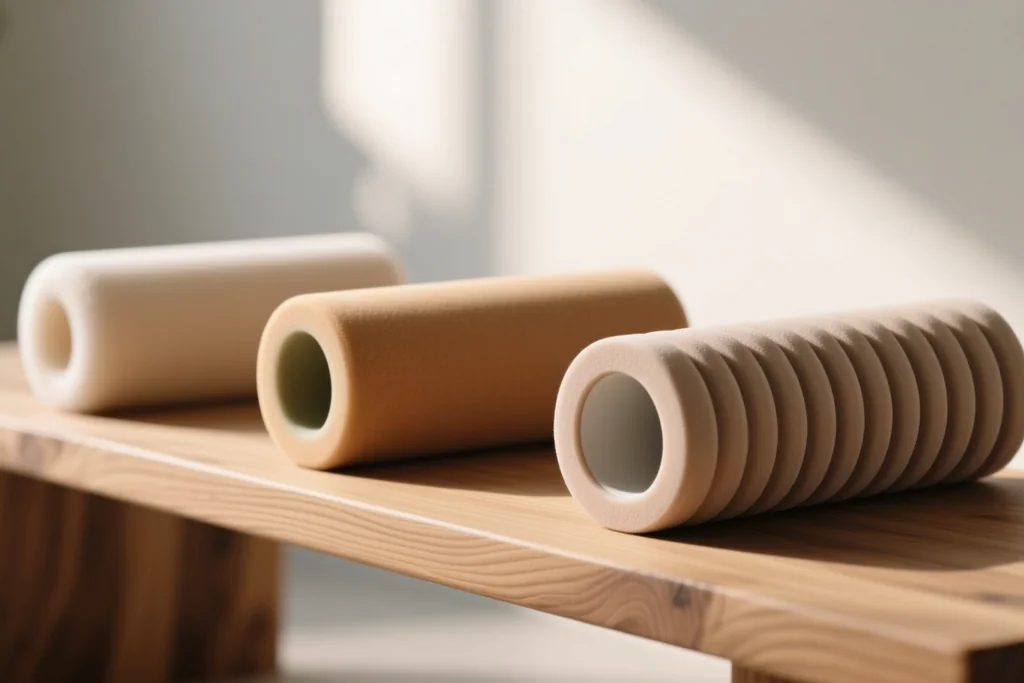
Foam rollers come in different densities, from soft (white foam, easily compressible) to firm (black or colored foam, barely compressible) to extra-firm (hollow core with rigid surface). The density that a runner needs depends on their experience with foam rolling, their body weight, and their tissue sensitivity — but most runners buy the firmest roller they can find, believing that more pressure equals more benefit. This belief is wrong.
A runner who is new to foam rolling and uses an extra-firm roller experiences pain that the nervous system interprets as threat. When the nervous system perceives threat, it increases muscle tone — the opposite of what foam rolling is supposed to achieve. The runner who is grimacing, tensing, and holding their breath while rolling is signaling to their nervous system that something dangerous is happening, and the nervous system responds by tightening the very muscles the runner is trying to relax. The correct density is one that produces discomfort that is tolerable — a sensation of "good pain" that is intense enough to be felt but not so intense that the body braces against it.
A soft or medium-density roller is the right starting point for most runners. As the tissues adapt and the nervous system becomes accustomed to the stimulus, the runner can progress to a firmer roller. The progression is the same as in running: start easy, build gradually, and never push through pain that causes protective tension.
To understand how foam rolling mistakes affect different muscle groups and what the correct approach is for each area, it helps to compare the common errors with the proper technique.
Each muscle group responds differently to foam rolling, and the mistakes that are harmless in one area can be counterproductive or even dangerous in another.
| Muscle group | Common mistake | Why it is wrong | Correct approach | Duration |
|---|---|---|---|---|
| IT band (lateral thigh) | Rolling directly on the band with full body weight | IT band is connective tissue, not muscle; pressure compresses it against bone and increases irritation | Roll the TFL and glutes instead; roll the lateral quadriceps just in front of the band | 1–2 min on TFL and glutes |
| Lower back (lumbar spine) | Placing roller under lower back and rolling | Pressure applied to spine, not muscle; compresses organs against spine; risk of spinal injury | Roll thoracic spine (upper back) and glutes instead; stretch hip flexors | 1–2 min on thoracic spine |
| Quadriceps | Rolling too fast with full body weight | Speed prevents sustained pressure on mechanoreceptors; full weight may cause protective tension | Slow passes (1–2 cm/sec); pause on tender spots for 30–60 sec; use moderate pressure | 2–3 min per leg |
| Calves | Rolling with body weight on both legs simultaneously | Insufficient pressure; both legs share the load and neither gets adequate stimulus | Cross one leg over the other to increase pressure; roll slowly from ankle to knee | 1–2 min per calf |
| Hamstrings | Rolling too fast and skipping the attachment points | Speed misses the effect; attachment points near the sit bones are often the most restricted | Slow passes; pause near the ischial tuberosity (sit bone) where tension concentrates | 2–3 min per leg |
| Glutes | Using a large foam roller that cannot reach deep muscles | Large roller only hits the surface of the glutes; deep rotators and piriformis remain untouched | Use a lacrosse ball or small roller for deep glute work; large roller for surface passes | 2–3 min with ball |
| Hip flexors | Not rolling at all — assuming stretching is sufficient | Hip flexors are chronically tight in runners and respond better to rolling plus stretching than to stretching alone | Use a small roller or ball to target the hip flexors just below the hip crease | 1–2 min per side |
| Adductors (inner thigh) | Avoiding the area because it is uncomfortable | Adductors are critical for running stability and are often restricted; avoiding them misses a key recovery area | Use the foam roller longitudinally, with the inner thigh on the roller; moderate pressure | 1–2 min per leg |
The table reveals that the correct approach varies significantly by muscle group — what works for the quads is wrong for the lower back, and what works for the glutes requires a different tool than what works for the IT band. The runner who applies the same technique to every area is making the most fundamental mistake of all: treating all tissue the same when it is not.
Mistake 5: Rolling the wrong direction
Foam rolling is not bidirectional in the way that stretching is. The roller should move in the direction of blood return — from the extremities toward the heart — to assist venous return and lymphatic drainage. Rolling from the knee down to the ankle, or from the hip down to the knee, pushes fluid away from the heart and against the direction of venous return, which can increase swelling and delay recovery.
The correct direction is distal to proximal: from ankle to calf, from knee to thigh, from elbow to shoulder. The pressure assists the one-way valves in the veins that return blood to the heart, and the vascular flushing effect is enhanced when the direction of rolling matches the direction of blood flow. This does not mean that rolling in the wrong direction is harmful — it is simply less effective. But the runner who rolls both directions equally is wasting half of their rolling time on a technique that produces less benefit.
Mistake 6: Rolling cold muscles
Foam rolling a cold muscle — one that has not been warmed up — is less effective and more uncomfortable than rolling a warm muscle. Cold tissue is less pliable, the mechanoreceptors are less responsive, and the nervous system is more likely to interpret pressure as threat. The runner who rolls first thing in the morning, before any movement, experiences more pain and gets less benefit than the runner who rolls after a warm-up or after a run.
The ideal time to foam roll is after the run, when the muscles are warm, blood flow is elevated, and the tissue is most responsive. Rolling post-run takes advantage of the elevated tissue temperature to maximize the neurological and vascular effects. If rolling is used as a pre-run warm-up tool, the runner should do five minutes of light movement — walking, easy jogging, or dynamic stretching — before rolling, to raise tissue temperature and prepare the nervous system for the stimulus.
Mistake 7: Using the foam roller as a replacement for stretching
Foam rolling and stretching are not interchangeable — they produce different effects and should be used as complements, not substitutes. Foam rolling reduces muscle tone and improves tissue mobility; stretching improves range of motion by lengthening the muscle and tendon. The runner who replaces stretching with foam rolling misses the lengthening effect, and the runner who replaces foam rolling with stretching misses the tone-reduction effect.
The most effective recovery routine uses both: foam roll first to reduce muscle tone and make the tissue more receptive to stretching, then stretch to improve range of motion. The sequence matters because foam rolling prepares the nervous system for stretching — the reduced tone makes the muscle less resistant to lengthening, and the stretch is more effective as a result. A post-run routine of five minutes of foam rolling followed by five minutes of targeted stretching produces better results than ten minutes of either alone.
Mistake 8: Ignoring the glutes and hips
Runners tend to foam roll the areas they can see and feel easily — the quads, the calves, the hamstrings — and ignore the areas that are harder to reach and less visible but more important for running performance. The glutes and the hip muscles are the engine of running: they produce the force that drives the body forward, and they are the muscles that become most restricted in runners who sit for most of the day.
The gluteus maximus, gluteus medius, and the deep external rotators of the hip — including the piriformis — are chronically tight in most runners. Rolling these muscles requires a different approach than rolling the large muscles of the thigh: the glutes are thick and require more pressure, and the deep rotators are small and require a more targeted tool. A foam roller is effective for the surface of the glutes, but a lacrosse ball or massage ball is needed to reach the deep rotators that the roller cannot access.
Hip flexor rolling is equally neglected. The iliopsoas — the primary hip flexor — is one of the most important muscles in running and one of the most restricted in people who sit. Rolling the hip flexors requires a small roller or ball placed just below the hip crease, with the runner lying face down. The pressure is intense, and the area is sensitive, but the release of a chronically tight hip flexor can transform running mechanics more than any other rolling intervention.
Mistake 9: Rolling through sharp pain
There is a difference between the discomfort of foam rolling a tight muscle and the sharp pain of rolling damaged tissue. The discomfort of a tight muscle is diffuse, building gradually as pressure is applied, and it decreases as the tissue relaxes. Sharp, localized pain — the kind that makes the body recoil and the breath catch — is a signal that something is wrong: a muscle tear, tendon inflammation, or a stress fracture that should not be rolled.
The runner who rolls through sharp pain is not recovering — they are aggravating an injury. The foam roller is a recovery tool for healthy but tight tissue, not a treatment for acute injury. If rolling produces sharp pain in a specific location, the runner should stop rolling that area and seek professional assessment. The common belief that "if it hurts, it needs more rolling" is one of the most dangerous misconceptions in self-myofascial release.
To help runners build a foam rolling routine that avoids the common mistakes and targets the right muscles in the right order, a structured approach is more effective than ad hoc rolling.
Before starting a foam rolling routine, runners should follow a structured sequence that targets the muscles most affected by running while avoiding the areas where rolling is ineffective or dangerous.
Correct foam rolling sequence for runners:
- Glutes (2 minutes per side) — start with the large muscles of the hip, using the foam roller with full body weight. Sit on the roller, cross one ankle over the opposite knee, and lean into the side being rolled. Pause on any tender spots for 30–60 seconds. Switch sides.
- Piriformis and deep rotators (1 minute per side) — replace the foam roller with a lacrosse ball. Sit on the floor, place the ball under the glute, and lean into it. Find the tender spot in the center of the glute and hold pressure until the tenderness decreases. Switch sides.
- Hip flexors (1 minute per side) — lie face down with the roller or ball placed just below the hip crease. Apply moderate pressure and hold. This area is sensitive — start with light pressure and increase gradually.
- Quadriceps (2 minutes per leg) — lie face down with the roller under the thighs. Roll slowly from hip to knee, pausing on tender spots. Keep the core engaged to protect the lower back. Use moderate pressure — not full body weight if the pressure is too intense.
- Hamstrings (2 minutes per leg) — sit on the floor with the roller under the thighs. Roll slowly from the sit bone to the knee. Pause on tender spots near the sit bone, where tension concentrates.
- Calves (2 minutes per leg) — sit on the floor with the roller under the calves. Cross one leg over the other to increase pressure. Roll slowly from ankle to knee, pausing on tender spots.
- Adductors (1 minute per leg) — lie face down with one leg extended to the side, the inner thigh on the roller. Roll slowly along the inner thigh from the knee to the groin. Use moderate pressure — this area is sensitive.
- Thoracic spine (1 minute) — lie on the back with the roller perpendicular to the spine, under the shoulder blades. Support the head with the hands. Roll slowly from the base of the neck to the bottom of the rib cage. Do not roll the lower back.
Following this sequence ensures that the muscles most important for running are addressed in an order that maximizes the cumulative benefit — starting with the hips, where tension originates, and moving toward the extremities, where tension is felt.
How often should runners foam roll
The frequency of foam rolling depends on the runner's training load, their recovery needs, and their schedule. Daily foam rolling is not necessary for most runners, and the belief that "more is better" leads to over-rolling — a condition where the tissue becomes sensitized from too much pressure and too frequent stimulation, producing the opposite of the intended effect.
For runners training three to five days per week, foam rolling three to four times per week is sufficient. The best approach is to roll on the days following hard workouts — the day after a long run, the day after a speed session — when the muscles are most in need of recovery. Rolling on the same day as the workout, after the run, is also effective and convenient, as the muscles are warm and the recovery process can begin immediately.
Each session should last 10 to 15 minutes — long enough to address all the key muscle groups, short enough to be sustainable as a habit. The runner who spends 30 minutes rolling is either rolling too slowly (spending excessive time on one area) or rolling too many areas (targeting muscles that do not need attention). The 15-minute session, following the sequence above, covers the essential areas with adequate time per muscle.
Choosing the right foam roller
The foam roller market is saturated with options, and the choices can be overwhelming. The key variables are density, surface texture, size, and shape — and each variable affects the roller's suitability for different runners.
Density is the most important variable. As discussed, a soft or medium-density roller is the right starting point for most runners, especially those new to foam rolling. The runner who has been rolling for months and finds that the medium roller no longer produces adequate stimulus can progress to a firm roller. Extra-firm rollers — with a rigid PVC core — are for experienced users with high tissue density and tolerance.
Surface texture ranges from smooth to heavily textured with knobs and ridges. Smooth rollers provide uniform pressure and are best for broad muscle groups like the quads and hamstrings. Textured rollers target specific points and can be useful for reaching deeper tissue, but they are more aggressive and can cause discomfort that triggers protective tension. A smooth roller is the more versatile choice for most runners, with a lacrosse ball as the targeted tool for specific points.
Size matters less than most runners think. The standard length — 30 to 45 centimeters — is sufficient for all muscle groups. Longer rollers (60 to 90 centimeters) are useful for rolling the thoracic spine because they provide a stable platform, but they are not necessary for leg muscles. Shorter rollers (15 to 20 centimeters) are more portable but less stable. The diameter is standardized at approximately 15 centimeters, which provides the right balance of pressure and surface area.
To avoid common errors when buying and using a foam roller, several factors should guide the selection and the approach.
Before purchasing a foam roller and incorporating it into a recovery routine, runners should keep several practical considerations in mind to ensure the tool serves its purpose effectively.
Practical tips for foam roller selection and use:
- Start soft and progress gradually — a soft or medium-density roller is the right choice for beginners. Progressing to a firmer roller should happen when the current roller no longer produces adequate stimulus, not because a firmer roller is "better."
- Choose a smooth surface over textured knobs — smooth rollers provide uniform pressure that is less likely to trigger protective tension. Use a lacrosse ball for targeted pressure on specific points.
- Replace the roller when it loses density — foam rollers compress over time and lose their effectiveness. A roller that feels softer than when it was new needs replacing — typically after 6 to 12 months of regular use.
- Do not roll immediately before a race or hard workout — foam rolling can temporarily alter muscle tone and proprioception. Roll the day before or the day after, not immediately before a high-intensity effort.
- Breathe through the discomfort — holding the breath signals the nervous system that something is wrong. Slow, deep breathing signals safety and allows the nervous system to reduce muscle tone.
- Hydrate after rolling — the vascular flushing effect of foam rolling mobilizes metabolic waste products that need to be cleared through the kidneys. Drinking water after rolling supports this clearance.
- Do not roll joints or bones — the foam roller is for muscle and fascia, not for tendons, ligaments, or bones. Rolling the patella, the Achilles tendon directly, or the shin bone is ineffective and potentially harmful.
- Consistency beats duration — 10 minutes of rolling three times per week is more effective than 30 minutes once per week. The nervous system responds to repeated, consistent stimulus, not to occasional intense sessions.
These tips ensure that the foam roller serves its purpose as a recovery tool rather than becoming another piece of fitness equipment that gathers dust or, worse, causes discomfort without producing benefit.
The foam roller is a tool, not a religion
Foam rolling is not magic, and it is not the most important thing a runner can do for recovery. Sleep, nutrition, and progressive training are far more powerful determinants of recovery and performance than any self-massage technique. The foam roller is a tool that, used correctly, enhances recovery — and used incorrectly, wastes time and potentially causes harm. The runner who rolls correctly for ten minutes after a workout gets a meaningful recovery benefit. The runner who rolls incorrectly for thirty minutes gets sore, frustrated, and no closer to recovered.
The difference between the two is not the roller, the brand, or the price — it is the knowledge of what the tool does, what it does not do, and how to apply it in a way that works with the body rather than against it. The foam roller does not need to hurt to work. It does not need to be used every day to be effective. It does not need to cover every inch of the body to produce results. It needs to be applied slowly, with the right pressure, to the right areas, in a sequence that respects the way the body is built and the way running affects it. The runner who masters that — and it is mastery that takes ten minutes to learn and a lifetime to refine — has a recovery tool that costs less than a pair of running socks and pays dividends every mile.